Introduction

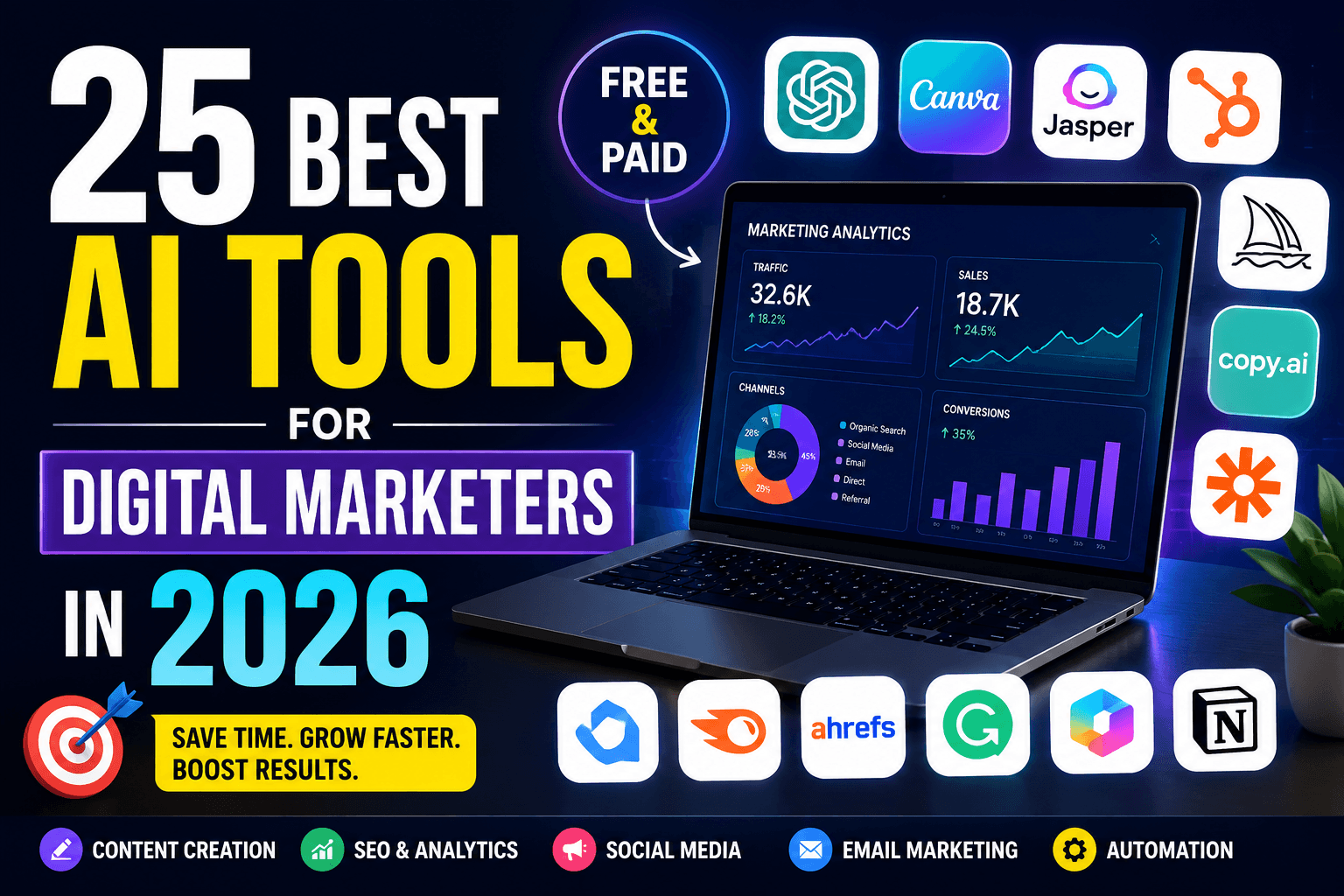
Digital marketing in 2026 is less about producing more assets and more about making better decisions across search, social, email, video, paid media, and customer journeys. The best AI tools for digital marketers accelerate research, remove repetitive production work, reveal patterns in campaign data, and help small teams execute ideas that once needed specialist departments.
This guide compares 25 practical platforms across content creation, SEO, social media, email marketing, creative production, analytics, and automation. It is written for US-based marketers, creators, freelancers, in-house teams, and agencies comparing free and paid options. Every recommendation includes limitations because AI output is only useful when it is accurate, differentiated, compliant, and connected to a measurable business goal.
If your priority is organic growth, also compare our best AI SEO tools. Teams building a broader operating stack can review the best AI business tools in 2026.

Why AI Matters for Digital Marketing in 2026

Customer journeys now span search engines, answer engines, social feeds, email, communities, marketplaces, and AI assistants. A marketer must understand intent, maintain a recognizable brand, personalize messages responsibly, and measure incremental impact across all of them. AI helps by compressing the time between a question and a testable campaign.
The competitive advantage is not access to a chatbot—most competitors have that. Advantage comes from proprietary customer insight, clean first-party data, clear positioning, strong creative judgment, and reliable workflows. AI amplifies those inputs. When the inputs are weak, it can simply produce more average content at greater speed.
Responsible teams keep humans accountable for claims, consent, copyright, privacy, accessibility, and final publishing. They also separate brainstorming from factual research and never upload confidential customer data without an approved policy and vendor agreement.

Benefits of AI Marketing Tools

  • Faster research: summarize interviews, compare themes, and find source trails.
  • More experiments: create structured variants for ads, emails, pages, and offers.
  • Consistent execution: encode brand voice, checklists, templates, and approval rules.
  • Better repurposing: turn one strong idea into channel-specific formats without copying blindly.
  • Operational efficiency: route leads, update records, generate reports, and alert owners automatically.
  • Accessible production: give lean teams practical writing, design, audio, and video capabilities.
These gains should be measured against time saved, conversion lift, qualified pipeline, retention, or reduced production cost. Output volume alone is a weak KPI and often creates expensive review work.

How We Selected These Tools

We assessed each platform against marketing usefulness, output control, learning curve, collaboration, integrations, pricing accessibility, data handling, and the quality of its free plan or trial. We favored tools that solve a recurring job instead of adding AI as a decorative feature.
Ratings are editorial comparisons, not laboratory guarantees. Product features and prices change frequently, so confirm current plan limits, usage rights, privacy terms, and integration availability on the official website before buying. A tool earned a high score when it could fit a real workflow and when its limitations were understandable enough to manage.
Our shortlist deliberately mixes general assistants with specialist marketing software. Most teams need one general research/writing assistant, one creative suite, one channel system of record, and a small number of automations—not subscriptions to all 25 products.

Top 25 AI Tools for Digital Marketers: Quick Comparison

Use this table as a shortlist, then read the individual reviews for workflow fit and limitations.
ToolBest ForStarting PriceRating
1. ChatGPTcampaign research, briefs, and flexible copyFree; Plus from $20/month4.9/5
2. Claudelong-form strategy and natural editorial workFree; Pro from $20/month4.8/5
3. GeminiGoogle-connected research and multimodal workFree; premium plans available4.7/5
4. Jasper AIon-brand marketing content at scalePaid plans; trial may be available4.7/5
5. Copy.aigo-to-market workflows and copy operationsFree access may be available; paid plans vary4.6/5
6. WritesonicSEO content production and fast campaign draftsFree trial/limited access; paid plans vary4.5/5
7. Surfer SEOon-page optimization and content briefsPaid plans; pricing varies4.7/5
8. Semrush AIall-in-one SEO and competitive intelligenceLimited free tools; paid suites vary4.8/5
9. Ahrefs AIbacklink, keyword, and content opportunity researchFree webmaster tools; paid plans vary4.8/5
10. Canva Magic Studiofast social, presentation, and ad creativeFree plan; Pro and team plans available4.8/5
11. Adobe Fireflycommercial creative production and image editingFree credits; premium access varies4.7/5
12. HubSpot AICRM-connected inbound marketing and lifecycle automationFree CRM tools; paid hubs vary4.8/5
13. Notion AIcampaign planning and marketing knowledge managementNotion plans with AI options4.6/5
14. Zapier AIno-code marketing automation across appsFree plan; paid automation plans vary4.8/5
15. Buffer AIsimple social scheduling and caption ideationFree plan; paid plans vary by channel4.6/5
16. Hootsuite AImulti-brand social management and governancePaid plans; demos may be available4.6/5
17. Descriptpodcast and video editing through textFree plan; paid creator plans available4.7/5
18. Synthesiapresenter-led videos without a studioDemo/free options may vary; paid plans available4.6/5
19. Pictoryturning scripts and articles into short videosTrial available; paid plans vary4.4/5
20. Runwayadvanced generative video and creative experimentationFree credits; paid plans available4.7/5
21. ElevenLabsnatural AI voiceovers and multilingual audioFree plan; paid plans available4.8/5
22. Perplexity AIfast, source-linked market researchFree plan; Pro and enterprise plans available4.7/5
23. FraseSEO briefs and search-focused content workflowsPaid plans; trial terms vary4.6/5
24. Grammarly AIediting, tone, and brand consistencyFree plan; Pro, business, and enterprise plans4.7/5
25. Mailchimp AIemail campaigns for small and growing brandsLimited free plan; paid plans scale with contacts4.6/5

1. ChatGPT

Overview: ChatGPT is best suited to campaign research, briefs, and flexible copy. It can reduce production time when the team gives it a focused brief, approved source material, a defined audience, and a clear review owner.
Key AI Features: brief generation, data analysis, web research, image creation, and reusable custom assistants.
Integrations: Google Drive, Microsoft apps, Zapier, and API-based workflows. Integration depth can depend on the selected plan, region, administrator permissions, and third-party connectors.
Best Use Cases: Content calendars, persona interviews, ad variants, landing-page outlines, and campaign analysis. Start with one high-frequency workflow and compare quality, turnaround time, and business outcome against the previous process.
Pros: Strong fit for campaign research, briefs, and flexible copy; reduces repetitive work; supports faster iteration; can help non-specialists create a useful first draft.
Cons: Output still requires human fact-checking and brand review; usage limits and advanced collaboration may require a paid plan; results depend heavily on source quality and instructions.
Pricing: Free; Plus from $20/month. Verify current US pricing, taxes, credits, seat rules, and feature limits before subscribing.
Official Website: Visit ChatGPT.
Alternatives: Claude, Gemini, Jasper. The best alternative is the one that fits your existing stack, approval process, data policy, and primary acquisition channel.
Expert Opinion: The most versatile starting point for a small marketing team, but brand rules and human review are essential.
Overall Rating: 4.9/5

2. Claude

Overview: Claude is best suited to long-form strategy and natural editorial work. It can reduce production time when the team gives it a focused brief, approved source material, a defined audience, and a clear review owner.
Key AI Features: long-context analysis, document review, structured writing, and brand-aware project workspaces.
Integrations: Google Workspace, Slack, developer APIs, and automation platforms. Integration depth can depend on the selected plan, region, administrator permissions, and third-party connectors.
Best Use Cases: Research synthesis, messaging documents, newsletters, sales enablement, and editorial review. Start with one high-frequency workflow and compare quality, turnaround time, and business outcome against the previous process.
Pros: Strong fit for long-form strategy and natural editorial work; reduces repetitive work; supports faster iteration; can help non-specialists create a useful first draft.
Cons: Output still requires human fact-checking and brand review; usage limits and advanced collaboration may require a paid plan; results depend heavily on source quality and instructions.
Pricing: Free; Pro from $20/month. Verify current US pricing, taxes, credits, seat rules, and feature limits before subscribing.
Official Website: Visit Claude.
Alternatives: ChatGPT, Gemini, Jasper. The best alternative is the one that fits your existing stack, approval process, data policy, and primary acquisition channel.
Expert Opinion: Our favorite for turning messy research into calm, readable strategy documents and polished long-form copy.
Overall Rating: 4.8/5

3. Gemini

Overview: Gemini is best suited to Google-connected research and multimodal work. It can reduce production time when the team gives it a focused brief, approved source material, a defined audience, and a clear review owner.
Key AI Features: multimodal analysis, deep research, image assistance, and Workspace drafting.
Integrations: Gmail, Docs, Sheets, Slides, Drive, and Google Ads workflows. Integration depth can depend on the selected plan, region, administrator permissions, and third-party connectors.
Best Use Cases: Search research, spreadsheet analysis, presentation drafts, email summaries, and creative ideation. Start with one high-frequency workflow and compare quality, turnaround time, and business outcome against the previous process.
Pros: Strong fit for Google-connected research and multimodal work; reduces repetitive work; supports faster iteration; can help non-specialists create a useful first draft.
Cons: Output still requires human fact-checking and brand review; usage limits and advanced collaboration may require a paid plan; results depend heavily on source quality and instructions.
Pricing: Free; premium plans available. Verify current US pricing, taxes, credits, seat rules, and feature limits before subscribing.
Official Website: Visit Gemini.
Alternatives: ChatGPT, Claude, Perplexity. The best alternative is the one that fits your existing stack, approval process, data policy, and primary acquisition channel.
Expert Opinion: Especially valuable for teams already operating inside Google Workspace; verify sources before publishing.
Overall Rating: 4.7/5

4. Jasper AI

Overview: Jasper AI is best suited to on-brand marketing content at scale. It can reduce production time when the team gives it a focused brief, approved source material, a defined audience, and a clear review owner.
Key AI Features: brand voice, campaign briefs, marketing templates, and multi-asset generation.
Integrations: CMS platforms, browser extensions, marketing workflows, and APIs. Integration depth can depend on the selected plan, region, administrator permissions, and third-party connectors.
Best Use Cases: Campaign launches, product messaging, paid-social variations, blog briefs, and repurposing. Start with one high-frequency workflow and compare quality, turnaround time, and business outcome against the previous process.
Pros: Strong fit for on-brand marketing content at scale; reduces repetitive work; supports faster iteration; can help non-specialists create a useful first draft.
Cons: Output still requires human fact-checking and brand review; usage limits and advanced collaboration may require a paid plan; results depend heavily on source quality and instructions.
Pricing: Paid plans; trial may be available. Verify current US pricing, taxes, credits, seat rules, and feature limits before subscribing.
Official Website: Visit Jasper AI.
Alternatives: Copy.ai, Writesonic, ChatGPT. The best alternative is the one that fits your existing stack, approval process, data policy, and primary acquisition channel.
Expert Opinion: A strong specialist choice when consistency across many writers and channels matters more than a general chatbot.
Overall Rating: 4.7/5

5. Copy.ai

Overview: Copy.ai is best suited to go-to-market workflows and copy operations. It can reduce production time when the team gives it a focused brief, approved source material, a defined audience, and a clear review owner.
Key AI Features: workflow automation, sales and marketing copy, prompt libraries, and structured outputs.
Integrations: CRM systems, automation tools, spreadsheets, and APIs. Integration depth can depend on the selected plan, region, administrator permissions, and third-party connectors.
Best Use Cases: Prospecting research, product descriptions, campaign briefs, nurture copy, and localization. Start with one high-frequency workflow and compare quality, turnaround time, and business outcome against the previous process.
Pros: Strong fit for go-to-market workflows and copy operations; reduces repetitive work; supports faster iteration; can help non-specialists create a useful first draft.
Cons: Output still requires human fact-checking and brand review; usage limits and advanced collaboration may require a paid plan; results depend heavily on source quality and instructions.
Pricing: Free access may be available; paid plans vary. Verify current US pricing, taxes, credits, seat rules, and feature limits before subscribing.
Official Website: Visit Copy.ai.
Alternatives: Jasper, Writesonic, ChatGPT. The best alternative is the one that fits your existing stack, approval process, data policy, and primary acquisition channel.
Expert Opinion: Best evaluated as a workflow platform rather than only a headline generator, particularly for repeatable GTM tasks.
Overall Rating: 4.6/5

6. Writesonic

Overview: Writesonic is best suited to SEO content production and fast campaign drafts. It can reduce production time when the team gives it a focused brief, approved source material, a defined audience, and a clear review owner.
Key AI Features: article generation, SEO assistance, brand controls, and conversational search tools.
Integrations: WordPress, browser workflows, publishing tools, and APIs. Integration depth can depend on the selected plan, region, administrator permissions, and third-party connectors.
Best Use Cases: SEO briefs, landing pages, product copy, content refreshes, and search-focused articles. Start with one high-frequency workflow and compare quality, turnaround time, and business outcome against the previous process.
Pros: Strong fit for SEO content production and fast campaign drafts; reduces repetitive work; supports faster iteration; can help non-specialists create a useful first draft.
Cons: Output still requires human fact-checking and brand review; usage limits and advanced collaboration may require a paid plan; results depend heavily on source quality and instructions.
Pricing: Free trial/limited access; paid plans vary. Verify current US pricing, taxes, credits, seat rules, and feature limits before subscribing.
Official Website: Visit Writesonic.
Alternatives: Jasper, Frase, Surfer SEO. The best alternative is the one that fits your existing stack, approval process, data policy, and primary acquisition channel.
Expert Opinion: Useful for speed, but its best results come after marketers replace generic claims with firsthand evidence.
Overall Rating: 4.5/5

7. Surfer SEO

Overview: Surfer SEO is best suited to on-page optimization and content briefs. It can reduce production time when the team gives it a focused brief, approved source material, a defined audience, and a clear review owner.
Key AI Features: SERP analysis, content scoring, topical suggestions, audits, and AI-assisted drafting.
Integrations: Google Docs, WordPress, content editors, and workflow connectors. Integration depth can depend on the selected plan, region, administrator permissions, and third-party connectors.
Best Use Cases: SEO briefs, refresh priorities, competitive coverage checks, and editor guidance. Start with one high-frequency workflow and compare quality, turnaround time, and business outcome against the previous process.
Pros: Strong fit for on-page optimization and content briefs; reduces repetitive work; supports faster iteration; can help non-specialists create a useful first draft.
Cons: Output still requires human fact-checking and brand review; usage limits and advanced collaboration may require a paid plan; results depend heavily on source quality and instructions.
Pricing: Paid plans; pricing varies. Verify current US pricing, taxes, credits, seat rules, and feature limits before subscribing.
Official Website: Visit Surfer SEO.
Alternatives: Frase, Semrush, Clearscope. The best alternative is the one that fits your existing stack, approval process, data policy, and primary acquisition channel.
Expert Opinion: Excellent as an optimization compass; do not treat its score as a substitute for originality or search intent.
Overall Rating: 4.7/5

8. Semrush AI

Overview: Semrush AI is best suited to all-in-one SEO and competitive intelligence. It can reduce production time when the team gives it a focused brief, approved source material, a defined audience, and a clear review owner.
Key AI Features: keyword discovery, competitor research, content guidance, site audits, and advertising intelligence.
Integrations: Google services, social platforms, reporting tools, and APIs. Integration depth can depend on the selected plan, region, administrator permissions, and third-party connectors.
Best Use Cases: Keyword portfolios, technical audits, competitor monitoring, content planning, and PPC research. Start with one high-frequency workflow and compare quality, turnaround time, and business outcome against the previous process.
Pros: Strong fit for all-in-one SEO and competitive intelligence; reduces repetitive work; supports faster iteration; can help non-specialists create a useful first draft.
Cons: Output still requires human fact-checking and brand review; usage limits and advanced collaboration may require a paid plan; results depend heavily on source quality and instructions.
Pricing: Limited free tools; paid suites vary. Verify current US pricing, taxes, credits, seat rules, and feature limits before subscribing.
Official Website: Visit Semrush AI.
Alternatives: Ahrefs, Surfer SEO, Moz. The best alternative is the one that fits your existing stack, approval process, data policy, and primary acquisition channel.
Expert Opinion: The broadest option for agencies that need research, reporting, SEO, and paid-search context in one account.
Overall Rating: 4.8/5

9. Ahrefs AI

Overview: Ahrefs AI is best suited to backlink, keyword, and content opportunity research. It can reduce production time when the team gives it a focused brief, approved source material, a defined audience, and a clear review owner.
Key AI Features: search intent classification, keyword clustering, content suggestions, backlink analysis, and site auditing.
Integrations: Looker Studio, reporting workflows, browser tools, and APIs. Integration depth can depend on the selected plan, region, administrator permissions, and third-party connectors.
Best Use Cases: Link-gap research, content decay analysis, competitor pages, technical SEO, and topic selection. Start with one high-frequency workflow and compare quality, turnaround time, and business outcome against the previous process.
Pros: Strong fit for backlink, keyword, and content opportunity research; reduces repetitive work; supports faster iteration; can help non-specialists create a useful first draft.
Cons: Output still requires human fact-checking and brand review; usage limits and advanced collaboration may require a paid plan; results depend heavily on source quality and instructions.
Pricing: Free webmaster tools; paid plans vary. Verify current US pricing, taxes, credits, seat rules, and feature limits before subscribing.
Official Website: Visit Ahrefs AI.
Alternatives: Semrush, Moz, SE Ranking. The best alternative is the one that fits your existing stack, approval process, data policy, and primary acquisition channel.
Expert Opinion: Its data is most powerful when marketers connect rankings to business value instead of chasing traffic alone.
Overall Rating: 4.8/5

10. Canva Magic Studio

Overview: Canva Magic Studio is best suited to fast social, presentation, and ad creative. It can reduce production time when the team gives it a focused brief, approved source material, a defined audience, and a clear review owner.
Key AI Features: text-to-image, background tools, resize, presentation generation, copy assistance, and video features.
Integrations: Social networks, cloud storage, publishing apps, and brand kits. Integration depth can depend on the selected plan, region, administrator permissions, and third-party connectors.
Best Use Cases: Social posts, display ads, lead magnets, thumbnails, pitch decks, and quick video assets. Start with one high-frequency workflow and compare quality, turnaround time, and business outcome against the previous process.
Pros: Strong fit for fast social, presentation, and ad creative; reduces repetitive work; supports faster iteration; can help non-specialists create a useful first draft.
Cons: Output still requires human fact-checking and brand review; usage limits and advanced collaboration may require a paid plan; results depend heavily on source quality and instructions.
Pricing: Free plan; Pro and team plans available. Verify current US pricing, taxes, credits, seat rules, and feature limits before subscribing.
Official Website: Visit Canva Magic Studio.
Alternatives: Adobe Express, Firefly, Microsoft Designer. The best alternative is the one that fits your existing stack, approval process, data policy, and primary acquisition channel.
Expert Opinion: The easiest creative AI suite for non-designers, provided teams lock templates and brand permissions first.
Overall Rating: 4.8/5

11. Adobe Firefly

Overview: Adobe Firefly is best suited to commercial creative production and image editing. It can reduce production time when the team gives it a focused brief, approved source material, a defined audience, and a clear review owner.
Key AI Features: generative fill, image generation, text effects, vector assistance, and creative editing.
Integrations: Photoshop, Illustrator, Express, Creative Cloud, and enterprise workflows. Integration depth can depend on the selected plan, region, administrator permissions, and third-party connectors.
Best Use Cases: Campaign concepts, product backgrounds, ad variants, mood boards, and asset resizing. Start with one high-frequency workflow and compare quality, turnaround time, and business outcome against the previous process.
Pros: Strong fit for commercial creative production and image editing; reduces repetitive work; supports faster iteration; can help non-specialists create a useful first draft.
Cons: Output still requires human fact-checking and brand review; usage limits and advanced collaboration may require a paid plan; results depend heavily on source quality and instructions.
Pricing: Free credits; premium access varies. Verify current US pricing, taxes, credits, seat rules, and feature limits before subscribing.
Official Website: Visit Adobe Firefly.
Alternatives: Canva, Midjourney, Runway. The best alternative is the one that fits your existing stack, approval process, data policy, and primary acquisition channel.
Expert Opinion: A sensible choice for professional creative teams that need AI inside familiar production software.
Overall Rating: 4.7/5

12. HubSpot AI

Overview: HubSpot AI is best suited to CRM-connected inbound marketing and lifecycle automation. It can reduce production time when the team gives it a focused brief, approved source material, a defined audience, and a clear review owner.
Key AI Features: content assistance, prospecting, forecasting, CRM summaries, chat, and campaign tools.
Integrations: HubSpot CRM, email, forms, ads, CMS, sales, and service hubs. Integration depth can depend on the selected plan, region, administrator permissions, and third-party connectors.
Best Use Cases: Lead capture, segmentation, nurture journeys, attribution, sales handoff, and customer service. Start with one high-frequency workflow and compare quality, turnaround time, and business outcome against the previous process.
Pros: Strong fit for CRM-connected inbound marketing and lifecycle automation; reduces repetitive work; supports faster iteration; can help non-specialists create a useful first draft.
Cons: Output still requires human fact-checking and brand review; usage limits and advanced collaboration may require a paid plan; results depend heavily on source quality and instructions.
Pricing: Free CRM tools; paid hubs vary. Verify current US pricing, taxes, credits, seat rules, and feature limits before subscribing.
Official Website: Visit HubSpot AI.
Alternatives: Salesforce, Mailchimp, ActiveCampaign. The best alternative is the one that fits your existing stack, approval process, data policy, and primary acquisition channel.
Expert Opinion: The strongest value appears when marketing, sales, and service teams share clean CRM data and lifecycle definitions.
Overall Rating: 4.8/5

13. Notion AI

Overview: Notion AI is best suited to campaign planning and marketing knowledge management. It can reduce production time when the team gives it a focused brief, approved source material, a defined audience, and a clear review owner.
Key AI Features: workspace search, meeting notes, writing support, databases, summaries, and document Q&A.
Integrations: Slack, Google Drive, calendars, project tools, and automations. Integration depth can depend on the selected plan, region, administrator permissions, and third-party connectors.
Best Use Cases: Content calendars, launch hubs, meeting summaries, research libraries, and SOPs. Start with one high-frequency workflow and compare quality, turnaround time, and business outcome against the previous process.
Pros: Strong fit for campaign planning and marketing knowledge management; reduces repetitive work; supports faster iteration; can help non-specialists create a useful first draft.
Cons: Output still requires human fact-checking and brand review; usage limits and advanced collaboration may require a paid plan; results depend heavily on source quality and instructions.
Pricing: Notion plans with AI options. Verify current US pricing, taxes, credits, seat rules, and feature limits before subscribing.
Official Website: Visit Notion AI.
Alternatives: ClickUp, Coda, Microsoft Copilot. The best alternative is the one that fits your existing stack, approval process, data policy, and primary acquisition channel.
Expert Opinion: A flexible campaign command center, though teams need disciplined database ownership to prevent workspace clutter.
Overall Rating: 4.6/5

14. Zapier AI

Overview: Zapier AI is best suited to no-code marketing automation across apps. It can reduce production time when the team gives it a focused brief, approved source material, a defined audience, and a clear review owner.
Key AI Features: natural-language workflow building, AI actions, agents, routing, extraction, and enrichment.
Integrations: Thousands of marketing, CRM, form, email, analytics, and productivity apps. Integration depth can depend on the selected plan, region, administrator permissions, and third-party connectors.
Best Use Cases: Lead routing, alerts, content distribution, CRM updates, reporting, and customer follow-up. Start with one high-frequency workflow and compare quality, turnaround time, and business outcome against the previous process.
Pros: Strong fit for no-code marketing automation across apps; reduces repetitive work; supports faster iteration; can help non-specialists create a useful first draft.
Cons: Output still requires human fact-checking and brand review; usage limits and advanced collaboration may require a paid plan; results depend heavily on source quality and instructions.
Pricing: Free plan; paid automation plans vary. Verify current US pricing, taxes, credits, seat rules, and feature limits before subscribing.
Official Website: Visit Zapier AI.
Alternatives: Make, n8n, HubSpot Operations Hub. The best alternative is the one that fits your existing stack, approval process, data policy, and primary acquisition channel.
Expert Opinion: The fastest way to connect a fragmented stack; document every automation and add error alerts before scaling.
Overall Rating: 4.8/5

15. Buffer AI

Overview: Buffer AI is best suited to simple social scheduling and caption ideation. It can reduce production time when the team gives it a focused brief, approved source material, a defined audience, and a clear review owner.
Key AI Features: post ideas, rewriting, channel adaptation, scheduling, and performance insights.
Integrations: Major social networks, browser tools, and content workflows. Integration depth can depend on the selected plan, region, administrator permissions, and third-party connectors.
Best Use Cases: Caption variants, cross-platform repurposing, publishing queues, and lightweight analytics. Start with one high-frequency workflow and compare quality, turnaround time, and business outcome against the previous process.
Pros: Strong fit for simple social scheduling and caption ideation; reduces repetitive work; supports faster iteration; can help non-specialists create a useful first draft.
Cons: Output still requires human fact-checking and brand review; usage limits and advanced collaboration may require a paid plan; results depend heavily on source quality and instructions.
Pricing: Free plan; paid plans vary by channel. Verify current US pricing, taxes, credits, seat rules, and feature limits before subscribing.
Official Website: Visit Buffer AI.
Alternatives: Hootsuite, Later, Metricool. The best alternative is the one that fits your existing stack, approval process, data policy, and primary acquisition channel.
Expert Opinion: A clean choice for creators and lean teams that want publishing discipline without enterprise complexity.
Overall Rating: 4.6/5

16. Hootsuite AI

Overview: Hootsuite AI is best suited to multi-brand social management and governance. It can reduce production time when the team gives it a focused brief, approved source material, a defined audience, and a clear review owner.
Key AI Features: caption ideation, social listening, scheduling, analytics, inbox workflows, and trend discovery.
Integrations: Major social platforms, CRM tools, analytics products, and app ecosystem connectors. Integration depth can depend on the selected plan, region, administrator permissions, and third-party connectors.
Best Use Cases: Brand monitoring, approvals, customer care, publishing, competitive tracking, and reporting. Start with one high-frequency workflow and compare quality, turnaround time, and business outcome against the previous process.
Pros: Strong fit for multi-brand social management and governance; reduces repetitive work; supports faster iteration; can help non-specialists create a useful first draft.
Cons: Output still requires human fact-checking and brand review; usage limits and advanced collaboration may require a paid plan; results depend heavily on source quality and instructions.
Pricing: Paid plans; demos may be available. Verify current US pricing, taxes, credits, seat rules, and feature limits before subscribing.
Official Website: Visit Hootsuite AI.
Alternatives: Buffer, Sprout Social, Metricool. The best alternative is the one that fits your existing stack, approval process, data policy, and primary acquisition channel.
Expert Opinion: Better suited to agencies and larger teams that need permissions, listening, and centralized reporting.
Overall Rating: 4.6/5

17. Descript

Overview: Descript is best suited to podcast and video editing through text. It can reduce production time when the team gives it a focused brief, approved source material, a defined audience, and a clear review owner.
Key AI Features: transcription, text-based editing, filler-word removal, audio cleanup, captions, and AI speech.
Integrations: YouTube, podcast hosts, cloud storage, and editing workflows. Integration depth can depend on the selected plan, region, administrator permissions, and third-party connectors.
Best Use Cases: Webinars, podcasts, product demos, interview clips, captions, and short-form repurposing. Start with one high-frequency workflow and compare quality, turnaround time, and business outcome against the previous process.
Pros: Strong fit for podcast and video editing through text; reduces repetitive work; supports faster iteration; can help non-specialists create a useful first draft.
Cons: Output still requires human fact-checking and brand review; usage limits and advanced collaboration may require a paid plan; results depend heavily on source quality and instructions.
Pricing: Free plan; paid creator plans available. Verify current US pricing, taxes, credits, seat rules, and feature limits before subscribing.
Official Website: Visit Descript.
Alternatives: Adobe Premiere Pro, CapCut, Riverside. The best alternative is the one that fits your existing stack, approval process, data policy, and primary acquisition channel.
Expert Opinion: Its transcript-first workflow makes marketers faster without requiring traditional timeline-editing expertise.
Overall Rating: 4.7/5

18. Synthesia

Overview: Synthesia is best suited to presenter-led videos without a studio. It can reduce production time when the team gives it a focused brief, approved source material, a defined audience, and a clear review owner.
Key AI Features: AI avatars, multilingual voices, script-to-video, templates, collaboration, and localization.
Integrations: LMS platforms, content systems, collaboration tools, and APIs. Integration depth can depend on the selected plan, region, administrator permissions, and third-party connectors.
Best Use Cases: Product explainers, onboarding, localized campaigns, training, and personalized video. Start with one high-frequency workflow and compare quality, turnaround time, and business outcome against the previous process.
Pros: Strong fit for presenter-led videos without a studio; reduces repetitive work; supports faster iteration; can help non-specialists create a useful first draft.
Cons: Output still requires human fact-checking and brand review; usage limits and advanced collaboration may require a paid plan; results depend heavily on source quality and instructions.
Pricing: Demo/free options may vary; paid plans available. Verify current US pricing, taxes, credits, seat rules, and feature limits before subscribing.
Official Website: Visit Synthesia.
Alternatives: HeyGen, Colossyan, Pictory. The best alternative is the one that fits your existing stack, approval process, data policy, and primary acquisition channel.
Expert Opinion: Most useful for repeatable informational video; disclose synthetic presenters where audience trust could be affected.
Overall Rating: 4.6/5

19. Pictory

Overview: Pictory is best suited to turning scripts and articles into short videos. It can reduce production time when the team gives it a focused brief, approved source material, a defined audience, and a clear review owner.
Key AI Features: script-to-video, article conversion, automatic highlights, captions, and stock-media assembly.
Integrations: Publishing platforms, cloud assets, social workflows, and team tools. Integration depth can depend on the selected plan, region, administrator permissions, and third-party connectors.
Best Use Cases: Blog repurposing, faceless explainers, social clips, summaries, and basic promo videos. Start with one high-frequency workflow and compare quality, turnaround time, and business outcome against the previous process.
Pros: Strong fit for turning scripts and articles into short videos; reduces repetitive work; supports faster iteration; can help non-specialists create a useful first draft.
Cons: Output still requires human fact-checking and brand review; usage limits and advanced collaboration may require a paid plan; results depend heavily on source quality and instructions.
Pricing: Trial available; paid plans vary. Verify current US pricing, taxes, credits, seat rules, and feature limits before subscribing.
Official Website: Visit Pictory.
Alternatives: InVideo, Synthesia, Descript. The best alternative is the one that fits your existing stack, approval process, data policy, and primary acquisition channel.
Expert Opinion: A practical repurposing tool for teams prioritizing volume, but final footage and pacing still need human editing.
Overall Rating: 4.4/5

20. Runway

Overview: Runway is best suited to advanced generative video and creative experimentation. It can reduce production time when the team gives it a focused brief, approved source material, a defined audience, and a clear review owner.
Key AI Features: text/image-to-video, motion controls, background removal, video transformation, and creative models.
Integrations: Professional editing pipelines, asset storage, and creative production tools. Integration depth can depend on the selected plan, region, administrator permissions, and third-party connectors.
Best Use Cases: Concept films, campaign visuals, product scenes, motion experiments, and social ads. Start with one high-frequency workflow and compare quality, turnaround time, and business outcome against the previous process.
Pros: Strong fit for advanced generative video and creative experimentation; reduces repetitive work; supports faster iteration; can help non-specialists create a useful first draft.
Cons: Output still requires human fact-checking and brand review; usage limits and advanced collaboration may require a paid plan; results depend heavily on source quality and instructions.
Pricing: Free credits; paid plans available. Verify current US pricing, taxes, credits, seat rules, and feature limits before subscribing.
Official Website: Visit Runway.
Alternatives: Adobe Firefly, Pika, Luma. The best alternative is the one that fits your existing stack, approval process, data policy, and primary acquisition channel.
Expert Opinion: The best fit here for creative teams willing to iterate; consistency and usage rights still need project-level review.
Overall Rating: 4.7/5

21. ElevenLabs

Overview: ElevenLabs is best suited to natural AI voiceovers and multilingual audio. It can reduce production time when the team gives it a focused brief, approved source material, a defined audience, and a clear review owner.
Key AI Features: text-to-speech, voice design, dubbing, sound effects, and multilingual localization.
Integrations: Video editors, APIs, publishing workflows, and automation tools. Integration depth can depend on the selected plan, region, administrator permissions, and third-party connectors.
Best Use Cases: Ad voiceovers, podcast narration, localized videos, audio articles, and product demos. Start with one high-frequency workflow and compare quality, turnaround time, and business outcome against the previous process.
Pros: Strong fit for natural AI voiceovers and multilingual audio; reduces repetitive work; supports faster iteration; can help non-specialists create a useful first draft.
Cons: Output still requires human fact-checking and brand review; usage limits and advanced collaboration may require a paid plan; results depend heavily on source quality and instructions.
Pricing: Free plan; paid plans available. Verify current US pricing, taxes, credits, seat rules, and feature limits before subscribing.
Official Website: Visit ElevenLabs.
Alternatives: Murf, PlayHT, Descript. The best alternative is the one that fits your existing stack, approval process, data policy, and primary acquisition channel.
Expert Opinion: Outstanding voice quality, but marketers must obtain consent for cloned voices and label synthetic media when appropriate.
Overall Rating: 4.8/5

22. Perplexity AI

Overview: Perplexity AI is best suited to fast, source-linked market research. It can reduce production time when the team gives it a focused brief, approved source material, a defined audience, and a clear review owner.
Key AI Features: cited answers, deep research, file analysis, spaces, and follow-up exploration.
Integrations: Browser workflows, enterprise knowledge, files, and APIs. Integration depth can depend on the selected plan, region, administrator permissions, and third-party connectors.
Best Use Cases: Competitor snapshots, trend research, source discovery, interview preparation, and claim verification. Start with one high-frequency workflow and compare quality, turnaround time, and business outcome against the previous process.
Pros: Strong fit for fast, source-linked market research; reduces repetitive work; supports faster iteration; can help non-specialists create a useful first draft.
Cons: Output still requires human fact-checking and brand review; usage limits and advanced collaboration may require a paid plan; results depend heavily on source quality and instructions.
Pricing: Free plan; Pro and enterprise plans available. Verify current US pricing, taxes, credits, seat rules, and feature limits before subscribing.
Official Website: Visit Perplexity AI.
Alternatives: ChatGPT, Gemini, Claude. The best alternative is the one that fits your existing stack, approval process, data policy, and primary acquisition channel.
Expert Opinion: Excellent for finding a research trail; marketers should open, evaluate, and cite the original sources rather than the summary.
Overall Rating: 4.7/5

23. Frase

Overview: Frase is best suited to SEO briefs and search-focused content workflows. It can reduce production time when the team gives it a focused brief, approved source material, a defined audience, and a clear review owner.
Key AI Features: SERP briefs, question discovery, content scoring, optimization, and AI writing assistance.
Integrations: Google Docs, WordPress, Search Console workflows, and team editors. Integration depth can depend on the selected plan, region, administrator permissions, and third-party connectors.
Best Use Cases: Content briefs, topic research, refreshes, FAQ discovery, and editor collaboration. Start with one high-frequency workflow and compare quality, turnaround time, and business outcome against the previous process.
Pros: Strong fit for SEO briefs and search-focused content workflows; reduces repetitive work; supports faster iteration; can help non-specialists create a useful first draft.
Cons: Output still requires human fact-checking and brand review; usage limits and advanced collaboration may require a paid plan; results depend heavily on source quality and instructions.
Pricing: Paid plans; trial terms vary. Verify current US pricing, taxes, credits, seat rules, and feature limits before subscribing.
Official Website: Visit Frase.
Alternatives: Surfer SEO, Clearscope, MarketMuse. The best alternative is the one that fits your existing stack, approval process, data policy, and primary acquisition channel.
Expert Opinion: A productive middle ground for content teams that want research and optimization in one focused workspace.
Overall Rating: 4.6/5

24. Grammarly AI

Overview: Grammarly AI is best suited to editing, tone, and brand consistency. It can reduce production time when the team gives it a focused brief, approved source material, a defined audience, and a clear review owner.
Key AI Features: rewriting, tone adjustment, ideation, proofreading, style guides, and brand controls.
Integrations: Browsers, email, document editors, desktop apps, and workplace tools. Integration depth can depend on the selected plan, region, administrator permissions, and third-party connectors.
Best Use Cases: Campaign QA, email polishing, tone alignment, executive posts, and copy review. Start with one high-frequency workflow and compare quality, turnaround time, and business outcome against the previous process.
Pros: Strong fit for editing, tone, and brand consistency; reduces repetitive work; supports faster iteration; can help non-specialists create a useful first draft.
Cons: Output still requires human fact-checking and brand review; usage limits and advanced collaboration may require a paid plan; results depend heavily on source quality and instructions.
Pricing: Free plan; Pro, business, and enterprise plans. Verify current US pricing, taxes, credits, seat rules, and feature limits before subscribing.
Official Website: Visit Grammarly AI.
Alternatives: Writer, LanguageTool, Microsoft Editor. The best alternative is the one that fits your existing stack, approval process, data policy, and primary acquisition channel.
Expert Opinion: A reliable final-mile editor, but marketers should review suggestions that may flatten distinctive brand language.
Overall Rating: 4.7/5

25. Mailchimp AI

Overview: Mailchimp AI is best suited to email campaigns for small and growing brands. It can reduce production time when the team gives it a focused brief, approved source material, a defined audience, and a clear review owner.
Key AI Features: subject-line help, content generation, segmentation, recommendations, and journey automation.
Integrations: E-commerce platforms, websites, CRM tools, social ads, and analytics. Integration depth can depend on the selected plan, region, administrator permissions, and third-party connectors.
Best Use Cases: Newsletters, welcome series, promotions, audience segmentation, and campaign reporting. Start with one high-frequency workflow and compare quality, turnaround time, and business outcome against the previous process.
Pros: Strong fit for email campaigns for small and growing brands; reduces repetitive work; supports faster iteration; can help non-specialists create a useful first draft.
Cons: Output still requires human fact-checking and brand review; usage limits and advanced collaboration may require a paid plan; results depend heavily on source quality and instructions.
Pricing: Limited free plan; paid plans scale with contacts. Verify current US pricing, taxes, credits, seat rules, and feature limits before subscribing.
Official Website: Visit Mailchimp AI.
Alternatives: Klaviyo, Brevo, ActiveCampaign. The best alternative is the one that fits your existing stack, approval process, data policy, and primary acquisition channel.
Expert Opinion: An accessible email starting point; forecast contact-based costs and clean inactive subscribers as the list grows.
Overall Rating: 4.6/5

Best AI Tools by Team and Budget

Top Free AI Tools

Start with ChatGPT, Claude, Gemini, Canva, Perplexity, Buffer, Grammarly, and limited free tiers from automation or creative platforms. Free access is ideal for validation, but review commercial rights, credit limits, and data-use settings.

Top Paid AI Tools

Semrush and Ahrefs are strong research investments; Jasper supports structured brand production; HubSpot connects marketing to CRM; Runway supports advanced video; and Zapier connects the stack. Buy only after a documented use case shows enough value to cover seats and review time.

Best AI Tools for Beginners

ChatGPT, Canva Magic Studio, Buffer, Grammarly, and Mailchimp offer familiar interfaces and quick wins. Beginners should use templates, keep approval steps simple, and learn one channel before automating several.

Best AI Tools for Agencies

Semrush, Ahrefs, Jasper, Hootsuite, HubSpot, Zapier, and Notion can support multi-client research, governance, delivery, and reporting. Agencies should separate client workspaces, restrict access, log approvals, and define ownership of generated assets.

Practical AI Marketing Stack Examples

Lean creator stack: Use ChatGPT or Claude for research and drafts, Canva for visual production, Buffer for scheduling, Mailchimp for email, and a lightweight analytics dashboard. This covers the core funnel without duplicating too many features.
SEO content stack: Use Perplexity for source discovery, Ahrefs or Semrush for opportunity research, Frase or Surfer for briefs, Claude for editorial development, and Grammarly for final QA. Search performance still depends on original expertise, useful examples, technical health, and earned authority.
Agency stack: Use Notion for client knowledge, Jasper for controlled copy workflows, Hootsuite for social governance, HubSpot for CRM-connected campaigns, Semrush for research/reporting, and Zapier for routing. Keep a human approval gate before every public or customer-facing action.
For independent client work, see our guide to the best AI tools for freelancers. Content teams can also explore the AI tools guide for content creators.

How to Choose the Right AI Marketing Software

Begin with the bottleneck, not the feature list. Write down the current task, frequency, owner, inputs, output standard, review time, data sensitivity, and metric affected. Shortlist two products, run the same representative task, and keep the test long enough to include normal edge cases.
Calculate total cost across subscriptions, seats, credits, setup, training, integration maintenance, review, and switching. A cheaper tool that produces unreliable work can cost more than a focused premium tool. Likewise, an all-in-one platform is wasteful if the team uses only its writing box.
Before rollout, approve data categories, access permissions, retention rules, disclosure requirements, and an exit plan. Export critical templates and keep source-of-truth customer data in an owned system rather than allowing an experimental AI app to become the only record.

Common Mistakes to Avoid

  • Publishing unverified claims, statistics, prices, or citations.
  • Automating a broken process before defining ownership and success metrics.
  • Uploading customer, employee, or client data without approval.
  • Using the same generic AI tone across every brand and channel.
  • Optimizing for content volume instead of qualified outcomes.
  • Buying overlapping tools without calculating total stack cost.
  • Letting SEO scores override reader intent and editorial judgment.
  • Cloning voices or likenesses without consent.
  • Launching automations without error handling, logs, and human escalation.
The safest pattern is draft, inspect, test, measure, and improve. AI should increase the quality of decisions as well as the speed of execution.

Frequently Asked Questions

Q1: What is the best AI tool for digital marketers in 2026?
A: ChatGPT is the best flexible starting point, while HubSpot is strongest for CRM-connected marketing, Semrush for broad SEO research, Canva for accessible design, and Zapier for cross-app automation.
Q2: Which AI marketing tools have free plans?
A: ChatGPT, Claude, Gemini, Canva, Perplexity, Buffer, Grammarly, and several other platforms provide free access or limited trials. Limits and commercial-use terms can change, so confirm them before production use.
Q3: What is the best AI tool for SEO?
A: Semrush and Ahrefs are strong research suites, Surfer SEO and Frase focus on content workflows, and no tool replaces technical SEO, original expertise, useful content, and quality backlinks.
Q4: Can AI write an entire marketing campaign?
A: AI can draft briefs, messages, variants, and assets, but a human should own positioning, factual accuracy, audience fit, legal review, brand quality, and the final launch decision.
Q5: Which AI tool is best for social media marketing?
A: Buffer is approachable for lean teams, Hootsuite fits larger teams needing governance and listening, and Canva is excellent for rapid social creative production.
Q6: What is the best AI email marketing tool?
A: Mailchimp is accessible for small brands, while HubSpot is better when email must connect deeply to CRM and lifecycle data. The right choice depends on list size, segmentation, automation, and reporting needs.
Q7: Are AI marketing tools safe for customer data?
A: Safety depends on the vendor, plan, contract, settings, and data category. Do not upload sensitive or regulated information without organizational approval, appropriate agreements, access controls, and a retention policy.
Q8: Will Google penalize AI-generated marketing content?
A: Search engines prioritize helpful quality and discourage scaled manipulation. Publishing generic, inaccurate, or mass-produced pages is risky regardless of how they were created. Add real expertise, evidence, editing, and reader value.
Q9: What AI tools are best for a digital marketing agency?
A: Semrush or Ahrefs, Jasper, Hootsuite, HubSpot, Zapier, and Notion form a capable agency stack, but client isolation, permissions, approvals, and cost controls are essential.
Q10: How much should a small business spend on AI marketing software?
A: Start with free tools and one paid product tied to a measurable bottleneck. Expand only after time saved or incremental profit clearly exceeds subscription, setup, and review costs.
Q11: Can AI replace digital marketers?
A: AI replaces portions of research, drafting, production, and administration. Marketers remain responsible for customer insight, strategy, taste, ethics, prioritization, stakeholder alignment, and commercial results.
Q12: What is the best AI tool for marketing videos?
A: Descript is excellent for transcript-based editing, Synthesia for presenter-led explainers, Pictory for basic repurposing, Runway for generative creative work, and ElevenLabs for voiceovers.
Q13: How do I measure ROI from an AI marketing tool?
A: Compare the old and new workflow using production hours, review time, campaign throughput, conversion quality, revenue, and error rates. Avoid claiming ROI from output volume alone.
Q14: Should marketers disclose AI-generated content?
A: Disclosure depends on context, platform rules, laws, and audience expectations. Be transparent when synthetic people, voices, endorsements, or material alterations could mislead a reasonable viewer.
Q15: How many AI marketing tools does a team need?
A: Most teams need a general assistant, a creative tool, channel systems of record, analytics, and selective automation. Choose the smallest stack that covers real workflows without duplicating features.
Continue building a practical, connected AI stack with these verified guides:

Conclusion

The best AI tools for digital marketers are the ones that strengthen a clear strategy instead of creating more disconnected output. ChatGPT and Claude are flexible thinking partners; Semrush, Ahrefs, Surfer, and Frase support search work; Canva, Firefly, Runway, Descript, Synthesia, and ElevenLabs expand creative capacity; HubSpot, Mailchimp, Buffer, and Hootsuite operate channels; and Zapier connects the system.
Choose one bottleneck, test two tools, document the workflow, and keep a human accountable for every public claim and customer interaction. Bookmark this guide for your next stack review, share it with a teammate who is comparing AI marketing software, and subscribe for more practical AI tool comparisons.