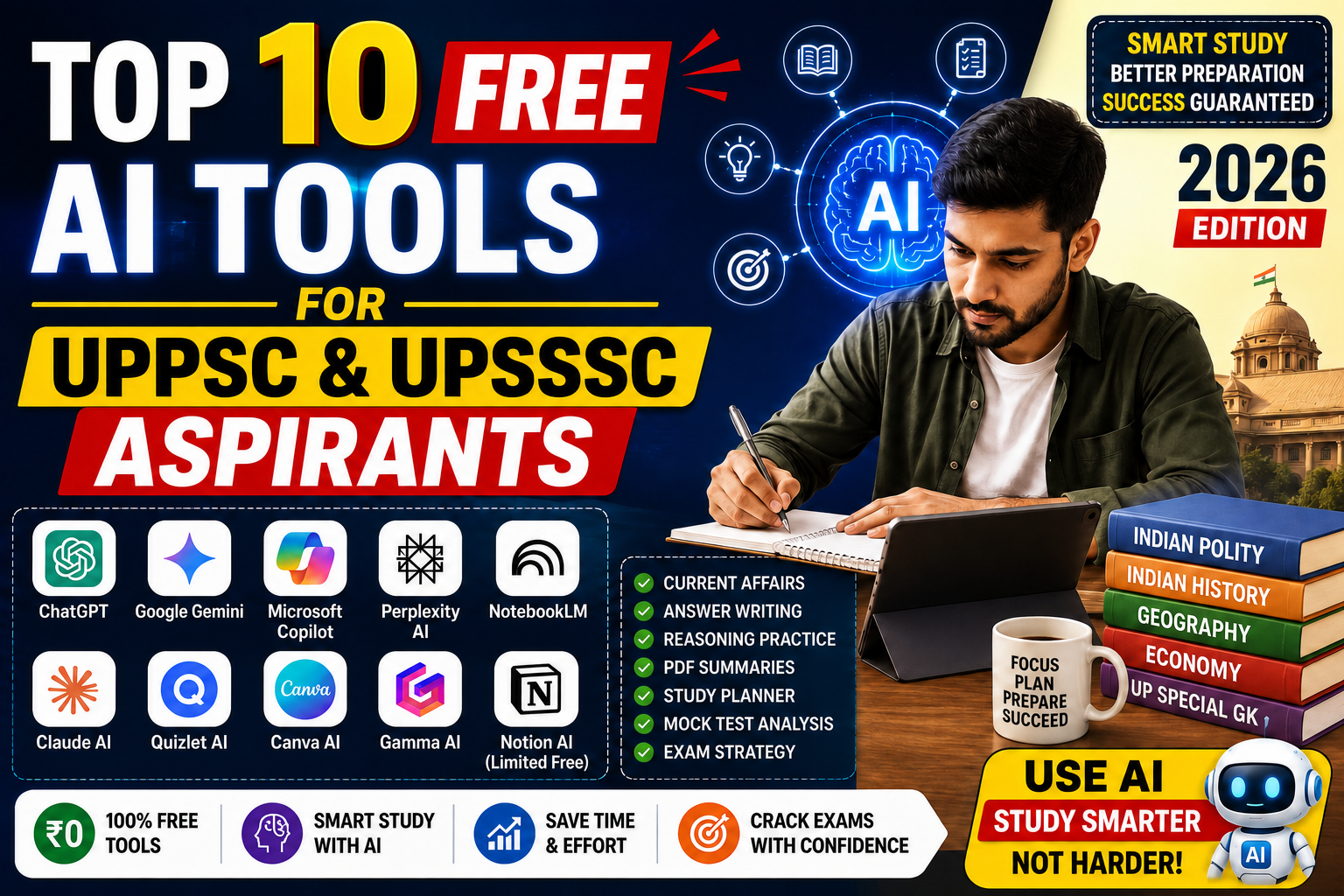
10 Free AI Tools for UPPSC & UPSSSC: 2026 Guide
Updated August 2, 2026 • 2026 Guide • 100% Free or Limited-Free • Expert Reviewed • 18–25 minute guide
Table of Contents
- 1. Why is AI changing government exam preparation?
- 2. How did we test and evaluate these free AI tools?
- 3. Which free AI tool is best? A quick comparison
- 4. Top 10 free AI tools for UPPSC and UPSSSC aspirants
- 5. How should aspirants use AI without cheating?
- 6. Which AI prompts work best?
- 7. What is the best 30-day implementation plan?
- 8. Frequently asked questions
What are the best free AI tools for UPPSC and UPSSSC aspirants?
Why is AI changing government exam preparation?
What benefits does AI offer UPPSC students?
What benefits does AI offer UPSSSC students?
How did we test and evaluate these free AI tools?
Which free AI tool is best? A quick comparison
| Tool | Free access | Current affairs | Answer writing | Reasoning | Hindi | Images | PDFs | Voice | Mobile |
|---|---|---|---|---|---|---|---|---|---|
| ChatGPT | Yes / limited | Useful | Strong | Strong | Strong | No / limited | Strong | Yes | Yes |
| Google Gemini | Yes / limited | Strong | Strong | Strong | Strong | Yes | Strong | Yes | Yes |
| Microsoft Copilot | Yes / limited | Strong | Supporting | Strong | Usable | Yes | Limited | Yes | Yes |
| Perplexity AI | Yes / limited | Strong | Supporting | Basic | Usable | No / limited | Limited | Varies | Yes |
| NotebookLM | Yes / limited | Useful | Supporting | Basic | Usable | No / limited | Strong | Varies | Web |
| Claude AI | Yes / limited | Useful | Strong | Basic | Strong | No / limited | Strong | Varies | Yes |
| Canva AI | Yes / limited | Useful | Supporting | Basic | Usable | Yes | Limited | Varies | Yes |
| Gamma AI | Yes / limited | Useful | Supporting | Basic | Usable | No / limited | Limited | Varies | Web |
| Notion AI | Yes / limited | Useful | Supporting | Basic | Usable | No / limited | Limited | Varies | Yes |
| Quizlet AI | Yes / limited | Useful | Supporting | Basic | Usable | No / limited | Limited | Varies | Yes |
Top 10 free AI tools for UPPSC and UPSSSC aspirants
1. Is ChatGPT useful for UPPSC and UPSSSC preparation?
Best for: answer writing, explanations, planning and mock interviews
Overview: ChatGPT can reduce repetitive preparation work while keeping the aspirant responsible for judgment. Pricing: A capable free tier with usage limits. Pricing, quotas and feature names change, so confirm the current offer on the official ChatGPT website. Key features: conversational tutoring, file analysis, structured writing, voice and web-assisted research.
| What works well | What to watch | Overall rating |
|---|---|---|
| versatile; easy to prompt; strong English and useful Hindi support | can sound confident when wrong; limits vary | 9.4/10 |
How students can use it: Connect one feature to one syllabus outcome. Use it to clarify a difficult concept, create questions from verified notes, critique a self-written response, organize revision or locate primary sources. Do not ask for an entire preparation strategy every day; save a reusable prompt and measure whether it improves accuracy, recall or writing speed.
Real example: Paste your own 200-word RO/ARO answer, the question and marking demand; ask for a rubric-based diagnosis, then rewrite it yourself.
Limitations: Do not treat generated facts, case law or current affairs as primary evidence. Expert tip: Ask it to question you before answering. A short diagnostic quiz exposes weak concepts better than another summary.
2. Is Google Gemini useful for UPPSC and UPSSSC preparation?
Best for: multimodal learning, Google-connected research and Hindi explanations
Overview: Google Gemini can reduce repetitive preparation work while keeping the aspirant responsible for judgment. Pricing: Free access is available; model and feature quotas apply. Pricing, quotas and feature names change, so confirm the current offer on the official Google Gemini website. Key features: text and image understanding, file work, voice conversations, research assistance and Google ecosystem integration.
| What works well | What to watch | Overall rating |
|---|---|---|
| good multimodal input; convenient on Android; useful bilingual explanations | citations and exact facts still need checking; availability differs by account | 9.1/10 |
How students can use it: Connect one feature to one syllabus outcome. Use it to clarify a difficult concept, create questions from verified notes, critique a self-written response, organize revision or locate primary sources. Do not ask for an entire preparation strategy every day; save a reusable prompt and measure whether it improves accuracy, recall or writing speed.
Real example: Upload a public map of Uttar Pradesh and ask for district-based geography questions, then verify locations with an official atlas.
Limitations: Never upload confidential identity documents, admit cards or private coaching material. Expert tip: Request the answer first in simple Hindi, then a 100-word exam-ready English version to build bilingual recall.
3. Is Microsoft Copilot useful for UPPSC and UPSSSC preparation?
Best for: web-grounded explanations, Edge users and quick study support
Overview: Microsoft Copilot can reduce repetitive preparation work while keeping the aspirant responsible for judgment. Pricing: A free consumer experience is available; quotas and premium features vary. Pricing, quotas and feature names change, so confirm the current offer on the official Microsoft Copilot website. Key features: web answers, drafting, image creation, voice and Microsoft product integration.
| What works well | What to watch | Overall rating |
|---|---|---|
| quick web context; accessible in Edge and Windows; useful visual aids | source quality can vary; long study projects need careful organization | 8.7/10 |
How students can use it: Connect one feature to one syllabus outcome. Use it to clarify a difficult concept, create questions from verified notes, critique a self-written response, organize revision or locate primary sources. Do not ask for an entire preparation strategy every day; save a reusable prompt and measure whether it improves accuracy, recall or writing speed.
Real example: Ask for a comparison of constitutional and statutory bodies, then cross-check every article and appointment rule with official sources.
Limitations: Open and assess every cited source instead of copying the synthesized answer. Expert tip: Use Copilot to discover sources, not as the final source in your handwritten notes.
4. Is Perplexity AI useful for UPPSC and UPSSSC preparation?
Best for: current affairs discovery and cited web research
Overview: Perplexity AI can reduce repetitive preparation work while keeping the aspirant responsible for judgment. Pricing: Free searches are available; advanced research and premium models are limited. Pricing, quotas and feature names change, so confirm the current offer on the official Perplexity AI website. Key features: source-linked answers, follow-up research, collections and file analysis.
| What works well | What to watch | Overall rating |
|---|---|---|
| citations are visible; fast issue mapping; helpful for current affairs | a citation may not support the exact sentence; paywalls can reduce context | 9.2/10 |
How students can use it: Connect one feature to one syllabus outcome. Use it to clarify a difficult concept, create questions from verified notes, critique a self-written response, organize revision or locate primary sources. Do not ask for an entire preparation strategy every day; save a reusable prompt and measure whether it improves accuracy, recall or writing speed.
Real example: Research a new Uttar Pradesh scheme by asking for objective, department, beneficiaries, funding and official notification, then open the notification.
Limitations: It is a discovery layer, not a substitute for UPPSC notifications, PIB or department documents. Expert tip: Filter your question to official domains and ask for publication dates; current affairs without dates are risky.
5. Is NotebookLM useful for UPPSC and UPSSSC preparation?
Best for: studying trusted PDFs, notes and source-bound revision
Overview: NotebookLM can reduce repetitive preparation work while keeping the aspirant responsible for judgment. Pricing: A useful free version is available; notebook and generation limits apply. Pricing, quotas and feature names change, so confirm the current offer on the official NotebookLM website. Key features: source-grounded chat, citations to uploaded material, summaries, study guides and audio overviews.
| What works well | What to watch | Overall rating |
|---|---|---|
| answers stay close to chosen sources; excellent for revision; citations point into documents | quality depends entirely on uploaded sources; OCR can misread scans | 9.5/10 |
How students can use it: Connect one feature to one syllabus outcome. Use it to clarify a difficult concept, create questions from verified notes, critique a self-written response, organize revision or locate primary sources. Do not ask for an entire preparation strategy every day; save a reusable prompt and measure whether it improves accuracy, recall or writing speed.
Real example: Create one notebook from the official PET syllabus, selected government reports and your notes; generate topic questions only from those sources.
Limitations: Poor or outdated PDFs produce poor notes; upload the latest official syllabus and clean documents. Expert tip: Keep one notebook per subject rather than a giant dump. Clear source boundaries improve retrieval and revision.
6. Is Claude AI useful for UPPSC and UPSSSC preparation?
Best for: long documents, nuanced feedback and analytical writing
Overview: Claude AI can reduce repetitive preparation work while keeping the aspirant responsible for judgment. Pricing: A free plan is offered with message limits that depend on demand and context. Pricing, quotas and feature names change, so confirm the current offer on the official Claude AI website. Key features: long-context reading, document analysis, writing feedback and structured reasoning.
| What works well | What to watch | Overall rating |
|---|---|---|
| clear long-form feedback; strong organization; handles lengthy material well | free limits can interrupt long sessions; current facts require sources | 9.0/10 |
How students can use it: Connect one feature to one syllabus outcome. Use it to clarify a difficult concept, create questions from verified notes, critique a self-written response, organize revision or locate primary sources. Do not ask for an entire preparation strategy every day; save a reusable prompt and measure whether it improves accuracy, recall or writing speed.
Real example: Give Claude an official commission extract plus your essay and ask whether every claim is supported by the extract.
Limitations: An elegant answer can still contain a factual error, so verify names, dates, articles and data. Expert tip: Request margin-style comments and a score breakdown instead of a replacement answer; you learn more from diagnosis.
7. Is Canva AI useful for UPPSC and UPSSSC preparation?
Best for: visual revision sheets, timelines, maps and presentation-style notes
Overview: Canva AI can reduce repetitive preparation work while keeping the aspirant responsible for judgment. Pricing: Canva has a free plan; AI credits and premium assets are limited. Pricing, quotas and feature names change, so confirm the current offer on the official Canva AI website. Key features: design templates, AI-assisted layouts, image tools, presentations and mobile editing.
| What works well | What to watch | Overall rating |
|---|---|---|
| fast visual notes; beginner-friendly; easy exports | decorating can waste time; some assets and AI actions are paid | 8.2/10 |
How students can use it: Connect one feature to one syllabus outcome. Use it to clarify a difficult concept, create questions from verified notes, critique a self-written response, organize revision or locate primary sources. Do not ask for an entire preparation strategy every day; save a reusable prompt and measure whether it improves accuracy, recall or writing speed.
Real example: Turn a verified list of Uttar Pradesh rivers and tributaries into a one-page revision map, then test yourself from a blank version.
Limitations: Visual polish does not improve recall unless the sheet is accurate and actively reviewed. Expert tip: Use one font system and three colors maximum; the goal is rapid recall, not social-media design.
8. Is Gamma AI useful for UPPSC and UPSSSC preparation?
Best for: rapid topic decks and visual chapter summaries
Overview: Gamma AI can reduce repetitive preparation work while keeping the aspirant responsible for judgment. Pricing: A limited free credit allowance is generally available; exports and branding can vary. Pricing, quotas and feature names change, so confirm the current offer on the official Gamma AI website. Key features: AI-generated presentations, documents, cards, web sharing and quick restyling.
| What works well | What to watch | Overall rating |
|---|---|---|
| creates a logical first outline quickly; visually engaging; easy to reorganize | generated slides may be generic; free credits are finite | 7.9/10 |
How students can use it: Connect one feature to one syllabus outcome. Use it to clarify a difficult concept, create questions from verified notes, critique a self-written response, organize revision or locate primary sources. Do not ask for an entire preparation strategy every day; save a reusable prompt and measure whether it improves accuracy, recall or writing speed.
Real example: Create a ten-card overview of Panchayati Raj, replace weak generic points with verified state-specific notes, and present it aloud.
Limitations: Never memorize generated slides before validating each statement against standard or official material. Expert tip: Build the deck after studying a topic, not before; generation then becomes retrieval practice.
9. Is Notion AI useful for UPPSC and UPSSSC preparation?
Best for: study databases, revision trackers and connected notes
Overview: Notion AI can reduce repetitive preparation work while keeping the aspirant responsible for judgment. Pricing: Notion offers free workspace features; AI access may be trialled or limited and can require payment. Pricing, quotas and feature names change, so confirm the current offer on the official Notion AI website. Key features: databases, templates, summaries, writing help, search and task organization.
| What works well | What to watch | Overall rating |
|---|---|---|
| excellent organization; flexible trackers; notes and planning live together | Notion AI is not fully unlimited-free; setup can become procrastination | 8.3/10 |
How students can use it: Connect one feature to one syllabus outcome. Use it to clarify a difficult concept, create questions from verified notes, critique a self-written response, organize revision or locate primary sources. Do not ask for an entire preparation strategy every day; save a reusable prompt and measure whether it improves accuracy, recall or writing speed.
Real example: Track every UPSSSC mock by date, topic, error type and next revision date; summarize recurring mistakes weekly.
Limitations: Treat it as the limited-free entry in this list and check the current offer before relying on AI features. Expert tip: Start with one table—topic, confidence, last revised, next action. Add fields only when they change decisions.
10. Is Quizlet AI useful for UPPSC and UPSSSC preparation?
Best for: flashcards, active recall and short mobile revision
Overview: Quizlet AI can reduce repetitive preparation work while keeping the aspirant responsible for judgment. Pricing: Core study options are available free; AI and advanced modes may have limits. Pricing, quotas and feature names change, so confirm the current offer on the official Quizlet AI website. Key features: flashcards, practice tests, matching, spaced review and AI-assisted study sets.
| What works well | What to watch | Overall rating |
|---|---|---|
| excellent for factual recall; convenient mobile sessions; easy sharing | user-made sets can contain errors; advanced features may be paid | 8.6/10 |
How students can use it: Connect one feature to one syllabus outcome. Use it to clarify a difficult concept, create questions from verified notes, critique a self-written response, organize revision or locate primary sources. Do not ask for an entire preparation strategy every day; save a reusable prompt and measure whether it improves accuracy, recall or writing speed.
Real example: Create verified cards for constitutional articles, Uttar Pradesh schemes and important dates; answer aloud before revealing each back.
Limitations: Verify public sets before using them and avoid recognizing answers without producing them from memory. Expert tip: Keep cards atomic. One question and one precise answer beat a paragraph that tests several facts at once.
How should aspirants use AI without cheating?
Which AI prompts work best for UPPSC and UPSSSC?
AI Prompt Box
I am preparing for UPPSC Mains. Evaluate my answer to [question] in [word limit]. First identify the demand. Score structure, factual accuracy, analysis, Uttar Pradesh relevance, examples and conclusion. Do not rewrite immediately. Ask me three improvement questions, then give a compact model outline. Mark every fact that needs verification.Create 15 [PET/Lekhpal/VDO/Junior Assistant] questions on [topic] at realistic difficulty. Use only the source text I provide. Mix direct, statement and application items. Hide the key until I submit answers. Then explain every error in simple Hindi and create five corrective questions.Map [dated issue] for a UPPSC aspirant: why in news, background, constitutional/legal basis, Uttar Pradesh impact, prelims facts, mains arguments and three official primary sources. State the publication date of each source and clearly label uncertainty.Act as a critical essay coach. For [topic], ask me for my thesis first. Challenge it with social, economic, ethical, historical, environmental and Uttar Pradesh perspectives. Suggest examples but flag those requiring verification. Do not draft the essay.इस उत्तर का मूल्यांकन UPPSC मुख्य परीक्षा के मानकों पर करें। पहले प्रश्न की मांग बताएं। भाषा, संरचना, तथ्य, उदाहरण, संतुलन और निष्कर्ष पर अलग-अलग प्रतिक्रिया दें। उत्तर को तुरंत दोबारा न लिखें; पहले सुधार के लिए पाँच संकेत दें। संदिग्ध तथ्यों को ‘सत्यापन आवश्यक’ लिखें।Quiz me from the verified notes below using active recall. Ask one question at a time, wait for my response, grade strict accuracy, and repeat missed concepts after five intervening questions. Do not introduce facts outside my notes.Build a realistic plan for [exam/date] using [hours] daily. My completed topics are [list], weak topics are [list], and next mock is [date]. Include recall, PYQs, timed practice, error-log review and buffers. Give minimum and stretch targets.Conduct a UPPSC personality-test simulation based on my DAF themes [themes]. Ask one concise question at a time, add respectful follow-ups, test balance and administrative judgment, and review clarity, honesty and structure after ten questions.Using only [official source], create 20 MCQs with plausible distractors. Provide paragraph/page support for the correct option after I answer. If the source does not support an item, discard it.Summarize this public official PDF for [exam]. Preserve dates, definitions, numerical data and exceptions. Create a one-page revision sheet, ten recall questions and a table of claims with page citations. Say ‘not found’ rather than infer.What is the best 30-day AI study workflow?
- Select one syllabus outcome.
- Study it from a trusted source.
- Recall or write without AI.
- Use AI for feedback or fresh questions.
- Verify corrections and log the error.
- Repeat after spaced intervals.
Which related AI guides should you read next?
Frequently asked questions
Which is the best free AI tool for UPPSC preparation?
ChatGPT is the best general starting point, while NotebookLM is better for source-bound PDF study and Perplexity is better for discovering current-affairs sources. The best choice depends on the task.
Which AI tool is best for UPSSSC PET preparation?
Use ChatGPT or Gemini for explanations and MCQs, Quizlet for factual recall, and NotebookLM for questions grounded in the official syllabus and trusted notes.
Are these AI tools completely free?
Every listed product has free access or a limited-free route, but quotas and premium boundaries can change. Notion AI and some advanced AI features are especially limited, so verify the current official plan.
Can AI predict UPPSC or UPSSSC questions?
No. AI can identify syllabus themes and generate practice questions, but it cannot reliably predict an examination paper. Claims of guaranteed questions should be ignored.
Can ChatGPT prepare UPPSC current affairs?
It can explain and organize current affairs, but time-sensitive facts must be checked against recent official releases, reputable reporting and the relevant government department.
Is AI useful for Hindi answer writing?
Yes. AI can flag structure, clarity and grammar in Hindi, but aspirants should preserve natural language and verify terminology from authoritative Hindi sources.
Can I upload coaching PDFs to AI tools?
Only if you own the material or have permission and the service's privacy terms are acceptable. Prefer public official documents and never upload confidential or pirated content.
Which AI tool summarizes PDFs best?
NotebookLM is excellent when you want answers tied to selected sources. Claude, Gemini and ChatGPT can also analyze documents, subject to file and usage limits.
How can AI help with UPPSC Mains answer writing?
Write the answer yourself first, then ask AI to assess demand, structure, evidence, balance, word limit and conclusion. Rewrite from feedback without copying its model answer.
How can AI help with UPSSSC reasoning?
Ask for stepwise explanations, similar practice sets and an error log. Solve each question before revealing the solution so AI does not turn practice into passive reading.
Is AI allowed in competitive exam preparation?
Using study tools during preparation is generally different from using unauthorized assistance during an examination. Always follow the commission's current examination rules and instructions.
Can AI replace coaching for UPPSC?
AI can supplement self-study and coaching, but it cannot replace a validated syllabus plan, standard books, tests, feedback and disciplined practice.
How do I stop AI hallucinations?
Ask for sources, dates and uncertainty; open the cited source; cross-check high-impact facts; and keep official notifications as the final authority.
Which tool is best for daily current affairs?
Perplexity is useful for source discovery, while NotebookLM is strong for revising a set of verified daily or monthly documents. Use official sources for final notes.
Can AI create a daily study plan?
Yes. Give the exact exam, available hours, syllabus status, test dates and weak topics. Review the plan weekly and change it based on results, not mood.
Which AI tool supports Hindi best?
ChatGPT, Gemini, Claude and Copilot can all work in Hindi, with quality varying by topic and prompt. Test terminology against official Hindi documents.
Can AI generate mock tests?
Yes, but generated questions may be ambiguous or incorrect. Ground them in a syllabus or trusted source and audit the answer key before scoring yourself.
Can AI analyze previous-year papers?
Yes. Provide legitimate question papers and ask for topic, difficulty and error-pattern classification. Do not infer future certainty from past frequency.
How much time should aspirants spend using AI?
Use AI only when it shortens a defined task. A practical ceiling is a small part of the study day; most time should remain reading, recalling, solving and writing.
Is NotebookLM useful for government exam students?
Yes. It is particularly useful for asking questions across a curated set of official PDFs and seeing source-linked support for answers.
Is Quizlet good for UPSSSC exams?
Yes for articles, schemes, vocabulary, dates, formulas and one-line facts. Combine flashcards with timed mixed tests to build application.
Can Canva AI improve exam preparation?
It can turn verified content into maps, timelines and revision sheets. Keep designs simple and ensure creating them takes less time than reviewing them.
What information should never be shared with AI?
Do not share passwords, Aadhaar or other identity numbers, payment data, private messages, admit-card details or confidential documents.
What is the safest AI study workflow?
Use trusted input, give a narrow prompt, inspect the output, verify important facts, transform it into a question or answer, and review it later through active recall.
Will AI guarantee selection in UPPSC or UPSSSC?
No tool can guarantee selection. AI can save time and improve feedback, but success still depends on eligibility, syllabus coverage, accuracy, revision, tests and exam performance.
Final verdict: should UPPSC and UPSSSC aspirants use AI in 2026?
Study smarter, then prove it in practice
Bookmark this guide, share it with UPPSC and UPSSSC friends, try one workflow today, and explore more New Banana Prompts AI guides. Your best AI stack is the one that produces stronger recall, cleaner answers and fewer repeated mistakes.
Read More AI Guides