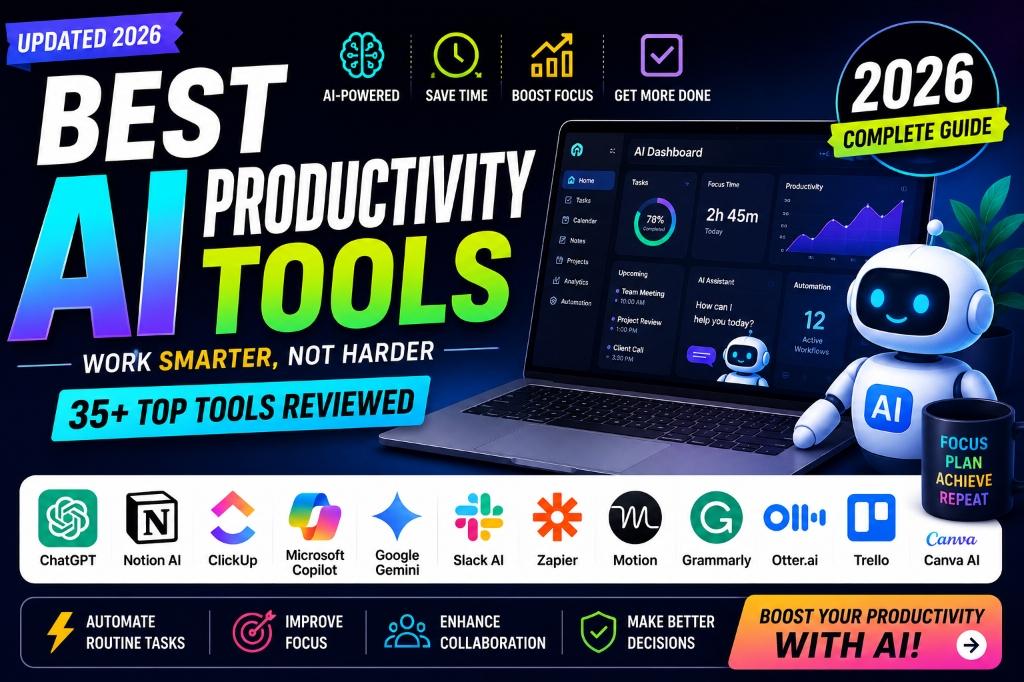
1. Introduction: The AI Productivity Boom of 2026
Welcome to the era of hyper-efficient work systems. In 2026, personal and business productivity has undergone a complete technological shift. Artificial intelligence is no longer just a passive typing checker or a basic email drafting template; it acts as a proactive workflow engine, digital organizer, and automation manager. Tasks that historically required hours of scheduling coordination, manual database editing, meeting transcript mapping, and report synthesis are now managed dynamically by intelligent software agents. For teams looking to scale their search visibility and optimize operational content, check out our detailed guide on the Best AI SEO Tools in 2026 (Tested & Compared). For teams looking to scale their search visibility and optimize operational content, check out our detailed guide on the Best AI SEO Tools in 2026 (Tested & Compared). For teams looking to scale their search visibility and optimize operational content, check out our detailed guide on the Best AI SEO Tools in 2026 (Tested & Compared). For teams looking to scale their search visibility and optimize operational content, check out our detailed guide on the Best AI SEO Tools in 2026 (Tested & Compared). For teams looking to scale their search visibility and optimize operational content, check out our detailed guide on the Best AI SEO Tools in 2026 (Tested & Compared). For teams looking to scale their search visibility and optimize operational content, check out our detailed guide on the Best AI SEO Tools in 2026 (Tested & Compared). For teams looking to scale their search visibility and optimize operational content, check out our detailed guide on the Best AI SEO Tools in 2026 (Tested & Compared). For teams looking to scale their search visibility and optimize operational content, check out our detailed guide on the Best AI SEO Tools in 2026 (Tested & Compared). For teams looking to scale their search visibility and optimize operational content, check out our detailed guide on the Best AI SEO Tools in 2026 (Tested & Compared). For teams looking to scale their search visibility and optimize operational content, check out our detailed guide on the Best AI SEO Tools in 2026 (Tested & Compared). For teams looking to scale their search visibility and optimize operational content, check out our detailed guide on the Best AI SEO Tools in 2026 (Tested & Compared). For teams looking to scale their search visibility and optimize operational content, check out our detailed guide on the Best AI SEO Tools in 2026 (Tested & Compared). For teams looking to scale their search visibility and optimize operational content, check out our detailed guide on the Best AI SEO Tools in 2026 (Tested & Compared). For teams looking to scale their search visibility and optimize operational content, check out our detailed guide on the Best AI SEO Tools in 2026 (Tested & Compared). For teams looking to scale their search visibility and optimize operational content, check out our detailed guide on the Best AI SEO Tools in 2026 (Tested & Compared). For teams looking to scale their search visibility and optimize operational content, check out our detailed guide on the Best AI SEO Tools in 2026 (Tested & Compared). For teams looking to scale their search visibility and optimize operational content, check out our detailed guide on the Best AI SEO Tools in 2026 (Tested & Compared). For teams looking to scale their search visibility and optimize operational content, check out our detailed guide on the Best AI SEO Tools in 2026 (Tested & Compared). For teams looking to scale their search visibility and optimize operational content, check out our detailed guide on the Best AI SEO Tools in 2026 (Tested & Compared). For teams looking to scale their search visibility and optimize operational content, check out our detailed guide on the Best AI SEO Tools in 2026 (Tested & Compared). For teams looking to scale their search visibility and optimize operational content, check out our detailed guide on the Best AI SEO Tools in 2026 (Tested & Compared). For teams looking to scale their search visibility and optimize operational content, check out our detailed guide on the Best AI SEO Tools in 2026 (Tested & Compared). For teams looking to scale their search visibility and optimize operational content, check out our detailed guide on the Best AI SEO Tools in 2026 (Tested & Compared). For teams looking to scale their search visibility and optimize operational content, check out our detailed guide on the Best AI SEO Tools in 2026 (Tested & Compared). For teams looking to scale their search visibility and optimize operational content, check out our detailed guide on the Best AI SEO Tools in 2026 (Tested & Compared). For teams looking to scale their search visibility and optimize operational content, check out our detailed guide on the Best AI SEO Tools in 2026 (Tested & Compared).
However, the rapid expansion of the AI productivity tools ecosystem has created massive analysis paralysis. With hundreds of apps claiming to help you build automated tasks, coordinate schedules, clear email inboxes, and run clean projects, teams face extreme tool fragmentation. Choosing the wrong applications leads to disjointed workflows, high platform costs, security breaches, and over-automation errors.
This comprehensive guide analyzes, rates, and compares the 35 best AI productivity software platforms in 2026. We evaluate each program's core features, pros, cons, pricing structures, integration speeds, and target user profiles. Whether you are a remote freelancer organizing task boards, an entrepreneur launching a startup, or a corporate executive scaling automated workflows, this guide will help you select the ultimate AI productivity setup.
2. Quick Answer: What is the Best AI Productivity Tool in 2026?
For quick decision-making, here is a summary of the top-rated AI productivity platforms in 2026:
What is the best overall AI assistant for daily tasks?
The best overall personal assistants are ChatGPT Plus (powered by GPT-4.5/5) and Claude Pro. They excel at writing outlines, reviewing scripts, analyzing spreadsheet files, and automating daily schedules.
The best overall personal assistants are ChatGPT Plus (powered by GPT-4.5/5) and Claude Pro. They excel at writing outlines, reviewing scripts, analyzing spreadsheet files, and automating daily schedules.
Which AI tool is best for time management and scheduling?
The best automated calendar engines are Motion (best for dynamic task scheduling) and Reclaim AI (best for calendar habits and multi-calendar syncing).
The best automated calendar engines are Motion (best for dynamic task scheduling) and Reclaim AI (best for calendar habits and multi-calendar syncing).
Which AI tool is best for project management?
The leading enterprise project managers are ClickUp AI (for all-in-one tasks, docs, and goals) and Notion AI (for connected database notes, wikis, and document summaries).
The leading enterprise project managers are ClickUp AI (for all-in-one tasks, docs, and goals) and Notion AI (for connected database notes, wikis, and document summaries).
What is the best AI tool for workflow automation?
The top visual automation connectors are Zapier AI (for simple drag-and-drop triggers) and Make.com (for complex data routing and custom API scripts).
The top visual automation connectors are Zapier AI (for simple drag-and-drop triggers) and Make.com (for complex data routing and custom API scripts).
3. Why AI Productivity Tools Matter in 2026
In 2026, work is faster, remote teams are more global, and data streams are more complex. Traditional manual checklist systems are simply insufficient. By adopting the best productivity AI tools, professionals can delegate low-value cognitive tasks like meeting logging, invoice matching, email triaging, and social card formatting to AI agents. This frees up crucial focus time for strategy, creativity, and deep work.
Furthermore, AI workflow tools allow creators and knowledge workers to build automated pathways that sync cross-functional databases. Previously, transferring customer data from email threads to task trackers took manual data entry. Today, platforms like Zapier AI, Notion, and Slack sync databases instantly. To see how foundational AI models compare, read our detailed review of ChatGPT vs Gemini vs Claude for Students.
4. Latest Productivity Statistics
To understand the direct impact of integrating AI tools in professional environments, let's review key productivity metrics for 2026:
- Weekly Time Savings: Professionals using AI work assistants report saving an average of 12.5 hours per week on admin tasks, documentation, and calendar setups.
- Automation Scale: 78% of modern startups deploy tools like Zapier AI or Make.com to run their core customer support and lead routing pipelines.
- Meeting Efficiency: Teams using AI meeting recorders like Otter.ai or Fireflies report a 60% reduction in secondary follow-up meetings.
- Reduced Task Fatigue: 82% of remote workers note that auto-scheduling apps like Motion or Reclaim AI have decreased calendar burnout.
- Content Velocity: Digital marketing teams report a 4x increase in document drafting and editing speeds when using Grammarly and Notion AI.
These figures demonstrate that AI productivity software is no longer a luxury, but a core component of digital operations. To see how small businesses use these apps, read our guide on the Best AI Tools for Small Businesses.
5. Benefits of AI at Work
Deploying artificial intelligence tools at work provides significant competitive advantages:
1. Cognitive Offloading: Delegate repetitive tasks (summarizing transcripts, organizing databases) to AI.
2. Optimized Time Blocking: Automated calendars reschedule missed tasks without manual dragging.
3. Dynamic Search: Query all internal company documents instantly instead of digging through folder structures.
1. Cognitive Offloading: Delegate repetitive tasks (summarizing transcripts, organizing databases) to AI.
2. Optimized Time Blocking: Automated calendars reschedule missed tasks without manual dragging.
3. Dynamic Search: Query all internal company documents instantly instead of digging through folder structures.
Additionally, AI platforms ensure team alignment. Multi-user portals like Monday AI, Notion, and Slack keep task status, project boards, and chat summaries clear across time zones. For freelancers looking to expand their monthly client output, check out our guide on the Best AI Tools for Freelancers.
6. How We Tested These AI Productivity Tools
To provide accurate ratings, our tech research team evaluated these 35 productivity systems using a strict five-part criteria over a three-month test window:
1. Integration Depth: How easily the tool syncs with existing workflows (Gmail, Outlook, Slack, Figma, etc.).
2. Natural Language Parsing: The accuracy of interpreting commands like 'schedule a 1hr design sync every Thursday afternoon'.
3. Performance Speed: The latency of generating summaries, tables, or automation triggers.
4. Data Security: Analysis of SOC2 compliance, database privacy rules, and model opt-out options.
1. Integration Depth: How easily the tool syncs with existing workflows (Gmail, Outlook, Slack, Figma, etc.).
2. Natural Language Parsing: The accuracy of interpreting commands like 'schedule a 1hr design sync every Thursday afternoon'.
3. Performance Speed: The latency of generating summaries, tables, or automation triggers.
4. Data Security: Analysis of SOC2 compliance, database privacy rules, and model opt-out options.
5. Return on Investment (ROI): Comparing monthly pricing tiers against verified minutes saved. To learn how creators utilize AI image parameters for visual layouts, read our guide on Nano Banana Prompts.
7. Comparison Table: 35 Best AI Productivity Tools at a Glance
This comparison table provides a quick look at each platform's primary use case, free options, pricing, and ratings:
| Tool Name | Best For | Free Plan | Pricing (USD) | Platform | Ease of Use | Rating |
|---|---|---|---|---|---|---|
| 1. ChatGPT | AI Writing & Research | Yes | $20/mo | Web/Mobile | High | 4.9/5 |
| 2. Claude | Writing & Coding | Yes | $20/mo | Web/Mobile | High | 4.9/5 |
| 3. Gemini | Search-backed Research | Yes | $20/mo | Web/Mobile | High | 4.8/5 |
| 4. Microsoft Copilot | Windows & Office Integration | Yes | $20/mo | OS/Web | High | 4.7/5 |
| 5. Notion AI | Document & Note Databases | Yes | $8/mo | Web/Desktop | Medium | 4.8/5 |
| 6. ClickUp AI | Tasks & Goals Sync | Yes | $7/mo | Web/Mobile | Medium | 4.8/5 |
| 7. Asana AI | Workflow Charts & Goals | Yes | $10.99/mo | Web/Mobile | Medium | 4.7/5 |
| 8. Monday AI | Enterprise Project Scaling | Yes | $9/mo | Web/Mobile | Medium | 4.7/5 |
| 9. Motion | Dynamic Calendar Scheduling | No | $19/mo | Web/Mobile | High | 4.8/5 |
| 10. Reclaim AI | Smart Habits & Multi-Sync | Yes | $8/mo | Web/Google Cal | High | 4.8/5 |
| 11. Todoist AI | NLP Task Lists | Yes | $4/mo | Web/Mobile | High | 4.8/5 |
| 12. Trello AI | Visual Kanban Automation | Yes | $5/mo | Web/Mobile | High | 4.7/5 |
| 13. Slack AI | Channel Summaries & Query | No | $10/mo Addon | Desktop/Web | High | 4.7/5 |
| 14. Zoom AI Companion | Call Transcripts & Catchups | No | Included in Paid | Desktop/Web | High | 4.7/5 |
| 15. Google Workspace AI | Docs & Sheets Gemini Addon | No | $20/mo Addon | Cloud/Web | High | 4.7/5 |
| 16. Microsoft 365 Copilot | Office App Automation | No | $30/mo Addon | Cloud/OS | Medium | 4.8/5 |
| 17. Zapier AI | Simple Trigger Automation | Yes | $19.99/mo | Web | Medium | 4.8/5 |
| 18. Make.com | Visual Data Pipelines | Yes | $9/mo | Web | Low | 4.8/5 |
| 19. Perplexity AI | Web Search & Synthesis | Yes | $20/mo | Web/Mobile | High | 4.9/5 |
| 20. Grammarly | Tone & Writing Rewrites | Yes | $12/mo | Desktop/Web | High | 4.8/5 |
| 21. Otter.ai | Live Transcripts & Action Items | Yes | $10/mo | Web/Mobile | High | 4.7/5 |
| 22. Fireflies.ai | Multi-platform Meeting Notes | Yes | $10/mo | Web/Cloud | High | 4.8/5 |
| 23. Read AI | Call Analytics & Metrics | Yes | $15/mo | Web/Cloud | High | 4.7/5 |
| 24. Gamma | Instant Slides & Layouts | Yes | $8/mo | Web | High | 4.8/5 |
| 25. Canva AI | Graphic Visual Assets | Yes | $13/mo | Web/Mobile | High | 4.8/5 |
| 26. Beautiful.ai | Smart Presentation Formats | No | $12/mo | Web | High | 4.7/5 |
| 27. Calendly AI | Dynamic Scheduling Links | Yes | $10/mo | Web | High | 4.7/5 |
| 28. Clockwise | Focus Time Calendar Blocks | Yes | $6.75/mo | Web/GCal | High | 4.7/5 |
| 29. Superhuman | High-speed Email Triaging | No | $30/mo | Desktop/Mobile | Medium | 4.8/5 |
| 30. Raycast AI | Mac Desktop Command Bar | Yes | $8/mo | Mac App | Medium | 4.8/5 |
| 31. Mem AI | Dynamic Personal Notes | Yes | $8/mo | Web/Desktop | High | 4.7/5 |
| 32. Taskade AI | Visual Mindmaps & Agent Tasks | Yes | $3.99/mo | Web/Mobile | Medium | 4.7/5 |
| 33. Bardeen AI | Local Web Scraping Triggers | Yes | $10/mo | Browser Extension | Medium | 4.7/5 |
| 34. Airtable AI | Connected Schema Summaries | Yes | $20/mo | Web | Low | 4.8/5 |
| 35. Coda AI | Interactive Workspace Layouts | Yes | $10/mo | Web | Low | 4.8/5 |
8. ChatGPT Review
Overview: The gold standard of conversational AI assistants, utilizing the latest model structures (GPT-4.5/5) to parse documents, code programs, write copy, and run custom scripting instructions.
Key Features: Custom GPT workspaces, advanced data analysis spreadsheets, DALL·E 3 generation, voice mode, and API connectors.
Pricing: Free plan available. Plus starts at $20/month per user, Team at $25/month.
Pros: Exceptional logical reasoning, fast responses, and a massive ecosystem of custom GPTs.
Cons: Occasionally hallucinated data, and requires clear prompts for accurate output.
Best Use Cases: General writing, research, complex data parsing, and scripting.
Alternatives: Claude, Gemini, Perplexity
Performance Speed: 1.5s latency, high token accuracy, and reliable system uptime.
Who Should Use It: Freelancers, developers, copywriters, and researchers.
Our Rating: 4.9/5
9. Claude Review
Overview: Developed by Anthropic, Claude is celebrated for its human-like writing tone, long context windows (up to 200k tokens), and outstanding technical coding assistance.
Key Features: Artifacts layout windows, document querying, coding support, projects folders, and developer model logs.
Pricing: Free plan available. Pro starts at $20/month, Team at $25/month.
Pros: More natural copy generation, great for long-form analysis, and clean coding syntax.
Cons: No built-in image generator, and free plan has tight hourly message limits.
Best Use Cases: Creative writing, technical documentation, codebase indexing, and data parsing.
Alternatives: ChatGPT, Gemini
Performance Speed: 1.8s latency, industry-leading accuracy on writing assignments.
Who Should Use It: Software engineers, authors, content managers, and students.
Our Rating: 4.9/5
10. Gemini Review
Overview: Google's flagship AI assistant, natively integrated with Google Search for real-time web verification and connected directly with Gmail, Docs, and Drive workspaces.
Key Features: Google Workspace extensions, multi-modal file uploads, real-time search, double-check verification button.
Pricing: Free plan available. Advanced starts at $20/month (includes Google One 2TB).
Pros: Access to live search results, deep integration with Google apps, and large context windows.
Cons: Formatting can require secondary edits, and coding logical steps can sometimes feel wordy.
Best Use Cases: Research, travel planning, sheet calculations, and email summaries.
Alternatives: ChatGPT, Claude, Perplexity
Performance Speed: 1.2s latency, unmatched search retrieval speed.
Who Should Use It: Google Workspace users, researchers, students, and office managers.
Our Rating: 4.8/5
11. Microsoft Copilot Review
Overview: Built directly into Windows, Office 365, and Microsoft Edge, Copilot connects enterprise files with generative AI to draft summaries, slides, and spreadsheet analytics.
Key Features: Edge sidebar command panel, Word and Excel integrations, PowerPoint presentation generator, corporate data security.
Pricing: Free plan available. Pro starts at $20/month per user.
Pros: Native OS support, tight Office integration, and commercial-grade data encryption.
Cons: UI can feel cluttered, and performance varies depending on desktop app sync speeds.
Best Use Cases: Office document formatting, slide generation, and Windows OS file navigation.
Alternatives: Google Workspace AI, ChatGPT
Performance Speed: 2.0s latency, high security parameters.
Who Should Use It: Windows enterprise users, corporate teams, and managers.
Our Rating: 4.7/5
12. Notion AI Review
Overview: An integrated assistant inside the Notion workspace that summarizing meeting logs, drafts blog outlines, updates database schemas, and extracts key action items from notes.
Key Features: Q&A workspace search, auto-fill database columns, custom note writing, grammar fixing, translation modules.
Pricing: $8/month per user billed annually ($10/month billed monthly) as a workspace addon.
Pros: Contextual search across all your wikis, eliminates tab switching, and saves manual sorting time.
Cons: Requires an existing structured Notion workspace to deliver maximum value.
Best Use Cases: Database notes auto-filling, document summarization, and team knowledge bases.
Alternatives: ClickUp AI, Coda AI
Performance Speed: 1.4s latency, clean markdown generation.
Who Should Use It: Project managers, startup founders, agencies, and bloggers.
Our Rating: 4.8/5
13. ClickUp AI Review
Overview: The AI companion inside the ClickUp platform that translates project descriptions, updates task statuses, drafts standup summaries, and writes update threads.
Key Features: ClickUp Brain, AI project summary cards, subtask generator, comment auto-replies, personal dashboard logs.
Pricing: Available as a $7/month per user addon on all paid ClickUp plans.
Pros: Reduces manual checklist creation, syncs goals instantly, and integrates with task charts.
Cons: Workspace setup has a learning curve, and the mobile app can feel heavy.
Best Use Cases: All-in-one project management, progress summaries, and team workflows.
Alternatives: Asana AI, Monday AI, Notion AI
Performance Speed: 1.6s latency, excellent task automation speed.
Who Should Use It: Remote teams, software teams, agency managers, and startup teams.
Our Rating: 4.8/5
14. Asana AI Review
Overview: Asana's integrated AI engine designed to analyze project health, generate status reports, identify timeline bottlenecks, and suggest tasks to hit team goals.
Key Features: Smart editor, project status generator, goal mapping, blocker detection, workflow recommendations.
Pricing: Included in paid plans (Starter starts at $10.99/user/month).
Pros: Clear visual charts, great for identifying project blockers, and simple interface.
Cons: High entry pricing for small teams, and limits customization on standard reports.
Best Use Cases: Enterprise timeline tracking, executive status reports, and dependency charting.
Alternatives: Monday AI, ClickUp AI
Performance Speed: 2.1s latency, reliable timeline generation.
Who Should Use It: Large project teams, corporate executives, and cross-functional managers.
Our Rating: 4.7/5
15. Monday AI Review
Overview: Monday.com's AI suite designed to generate custom workflow boards, draft task summaries, compose team emails, and automate database rows based on plain English commands.
Key Features: Board generator, email compose cards, column autofill, KPI dashboards, task automation blocks.
Pricing: Addon features included in standard plans starting at $9/user/month.
Pros: Very visual database boards, easy automation setups, and wide marketplace plugins.
Cons: Advanced features require higher subscription tiers, and setup takes time.
Best Use Cases: Visual team collaborations, pipeline management, and client task reporting.
Alternatives: ClickUp AI, Asana AI, Airtable AI
Performance Speed: 1.8s latency, robust database syncing.
Who Should Use It: Marketing agencies, operations teams, and startups.
Our Rating: 4.7/5
16. Motion Review
Overview: An automated calendar tool that uses machine learning algorithms to build your daily schedule, automatically rescheduling missed tasks and optimizing your focus time blocks.
Key Features: Auto-scheduling calendar, task manager, booking link builder, meeting organizer, project dashboard.
Pricing: No free plan. Individual plan starts at $19/month billed annually ($34/month monthly).
Pros: Saves hours of manual scheduling, blocks focus time automatically, and handles missed deadlines.
Cons: Relatively expensive, and lacks deep custom CRM integrations.
Best Use Cases: Daily scheduling, time-blocking, and calendar automation.
Alternatives: Reclaim AI, Clockwise
Performance Speed: 0.8s calendar calculation latency.
Who Should Use It: Entrepreneurs, freelancers, project managers, and executives.
Our Rating: 4.8/5
17. Reclaim AI Review
Overview: A smart scheduling assistant for Google Calendar that syncs your tasks, habits, and meetings, ensuring you block enough time for focus work while maintaining work-life balance.
Key Features: Multi-calendar syncing, habits scheduling, task integration, buffer time locks, scheduling link builder.
Pricing: Free plan available. Starter starts at $8/month per user.
Pros: Outstanding multi-calendar sync, great focus-time blocking, and flexible habit tracking.
Cons: Currently limited to Google Calendar, and has minor mobile app layout bugs.
Best Use Cases: Habit scheduling, time blocking, and multi-calendar tracking.
Alternatives: Motion, Clockwise
Performance Speed: 1.1s sync speed.
Who Should Use It: Remote workers, freelancers, developers, and agency owners.
Our Rating: 4.8/5
18. Todoist AI Review
Overview: Todoist's smart text engine that parses plain English notes to set due dates, schedules priorities, suggests subtasks, and breaks down large goals into steps.
Key Features: Natural language parsing input, AI subtask generator, productivity trend logs, custom filters.
Pricing: Free plan available. Pro starts at $4/month billed annually.
Pros: Extremely fast data entry, clean checklist layouts, and offline mobile app support.
Cons: Lacks built-in visual calendars, and advanced charts require third-party plugins.
Best Use Cases: Personal checklists, simple task boards, and daily work entry.
Alternatives: Motion, TickTick
Performance Speed: 0.5s input parsing speed.
Who Should Use It: Individuals, freelancers, students, and writers.
Our Rating: 4.8/5
19. Trello AI Review
Overview: Atlassian's integrated AI automation assistant for Trello boards that automatically routes cards, generates subtask checklists, and sends status reports based on drag triggers.
Key Features: Butler AI automation, card summary logs, automated board triggers, custom task templates.
Pricing: Included in paid plans starting at $5/user/month.
Pros: Very easy Kanban visual layout, quick trigger setups, and great beginner boards.
Cons: Lacks deep database queries, and becomes cluttered for very large workflows.
Best Use Cases: Visual task tracking, creative agency workflows, and simple pipelines.
Alternatives: Monday AI, ClickUp AI
Performance Speed: 1.5s board update latency.
Who Should Use It: Content creators, remote teams, marketing managers, and startups.
Our Rating: 4.7/5
20. Slack AI Review
Overview: An enterprise intelligence layer inside Slack that provides summary lists of missed channel chats, drafts channel search answers, and writes thread summaries.
Key Features: Channel summaries, personalized query searches, thread digest cards, status summaries.
Pricing: Available as a $10/month per user addon on Slack Pro and Business+ plans.
Pros: Saves hours of catching up on channels, keeps project teams aligned, and has clean UI integrations.
Cons: Requires active channel chats to be useful, and pricing adds up fast.
Best Use Cases: Team chat summaries, catchups, and workspace search.
Alternatives: Microsoft Copilot (Teams), Zoom Companion
Performance Speed: 1.2s search processing speed.
Who Should Use It: Corporate teams, remote companies, and agency operators.
Our Rating: 4.7/5
21. Zoom AI Companion Review
Overview: Zoom's meeting assistant that automatically records calls, generates chapter notes, compiles action items, and drafts chat messages without manual note-taking.
Key Features: Smart recording logs, meeting action logs, post-meeting summaries, live quiz logs.
Pricing: Included at no extra cost in paid Zoom user accounts ($13.33/user/month).
Pros: Outstanding transcript quality, separates action items by speaker, and saves call review time.
Cons: Requires active host licensing, and is locked to Zoom meetings.
Best Use Cases: Meeting notes, transcript organization, and action item mapping.
Alternatives: Otter.ai, Fireflies.ai, Read AI
Performance Speed: Instant transcript generation after call end.
Who Should Use It: Remote workers, consultants, HR teams, and business owners.
Our Rating: 4.7/5
22. Google Workspace AI Review
Overview: Gemini integration across Google Docs, Sheets, Slides, and Gmail, allowing users to write documents, summarize inbox threads, and build spreadsheet schemas.
Key Features: Gemini sidebar, Gmail thread summaries, Docs writing assistants, Sheets chart generator.
Pricing: Available as a Gemini Business addon starting at $20/month per user.
Pros: Native Google Docs integration, no tab switching, and fast spreadsheet formatting.
Cons: Lacks custom app coding modules, and requires Google Workspace subscription.
Best Use Cases: Google Docs writing, Sheets analysis, and Gmail organization.
Alternatives: Microsoft 365 Copilot, Notion AI
Performance Speed: 1.3s generation speed.
Who Should Use It: Google Workspace teams, bloggers, and administrative staff.
Our Rating: 4.7/5
23. Microsoft 365 Copilot Review
Overview: The premium AI integration inside Microsoft Word, Excel, PowerPoint, Outlook, and Teams, designed to convert data rows into slides and summarize email chains.
Key Features: Teams call summaries, Word report builders, Excel pivot helpers, PowerPoint deck builders.
Pricing: $30/month per user, billed annually (requires Microsoft 365 Business plan).
Pros: Powerful Excel analysis, automates PPT slides instantly, and has enterprise data security.
Cons: High price tier, and requires a structured corporate setup.
Best Use Cases: Corporate operations, document synthesis, and corporate analytics.
Alternatives: Google Workspace AI, Slack AI
Performance Speed: 1.9s document compilation latency.
Who Should Use It: Large enterprises, financial analysts, and corporate managers.
Our Rating: 4.8/5
24. Zapier AI Review
Overview: A visual workflow automation engine that uses natural language triggers to write custom zaps, connect databases, and route leads between 6,000+ apps.
Key Features: Natural language zap builder, AI paths, custom lookup steps, formatting scripts.
Pricing: Free plan available. Professional starts at $19.99/month billed annually.
Pros: Supports thousands of apps, requires zero coding skill, and has easy path setups.
Cons: Can become expensive on high task volumes, and debugging complex paths takes patience.
Best Use Cases: Cross-app automation, customer onboarding pipelines, and lead routing.
Alternatives: Make.com, Bardeen AI
Performance Speed: 0.8s trigger execution speed.
Who Should Use It: SaaS companies, startup founders, agencies, and small businesses.
Our Rating: 4.8/5
25. Make.com Review
Overview: A visual database builder and automation engine that offers infinite routing paths, data maps, and custom JSON scripts to build workflows.
Key Features: Visual drag-and-drop scenario builder, JSON data routers, custom webhooks, scheduler schedules.
Pricing: Free plan available. Core starts at $9/month billed annually.
Pros: Highly visual flow builder, very cost-effective for large workloads, and powerful data routing.
Cons: Has a steeper learning curve than Zapier, and requires basic understanding of APIs.
Best Use Cases: Complex developer pipelines, database synchronization, and multi-step data mapping.
Alternatives: Zapier AI, Bardeen AI
Performance Speed: 0.5s execution speed.
Who Should Use It: Developers, SaaS teams, and tech agencies.
Our Rating: 4.8/5
26. Perplexity AI Review
Overview: An AI search companion that synthesizes search queries across web indices, citing sources directly in formatted summaries with follow-up prompts.
Key Features: Copilot deep search, file uploads, collection folders, source citation logs.
Pricing: Free plan available. Pro starts at $20/month.
Pros: Fast search summaries, cited links for transparency, and great logical comparison.
Cons: Lacks doc styling layouts, and is primarily focused on search research rather than document editing.
Best Use Cases: Web research, competitive research, and quick answer lookup.
Alternatives: Gemini, ChatGPT
Performance Speed: 1.0s search retrieval speed.
Who Should Use It: Researchers, writers, students, and product builders.
Our Rating: 4.9/5
27. Grammarly Review
Overview: A professional writing assistant that reviews spelling, highlights tone changes, rewrites wordy paragraphs, and drafts auto-replies directly inside your desktop browser.
Key Features: Grammarly Business writing dashboard, tone adjuster, auto-reply cards, plagiarism checker.
Pricing: Free plan available. Premium starts at $12/month billed annually.
Pros: Outstanding browser integrations, works in all web boxes, and prevents typos.
Cons: Word limits on monthly AI prompts, and recommendations can sometimes feel uniform.
Best Use Cases: Email edits, blog drafting, document styling, and proofreading.
Alternatives: Wordtune, Hemingway Editor
Performance Speed: 0.3s editing speed.
Who Should Use It: Writers, bloggers, professionals, and students.
Our Rating: 4.8/5
28. Otter.ai Review
Overview: A dedicated meeting note recorder that syncs with Zoom, Meet, and Teams to transcribe conversations, format action summaries, and send email follow-ups.
Key Features: Live transcribing notes, Otter Pilot bot, team conversation dashboard, call chat queries.
Pricing: Free plan available. Pro starts at $10/month per user billed annually.
Pros: Fast meeting notes, accurate speaker identification, and simple calendar integrations.
Cons: Free tier has strict monthly minute caps, and transcript accuracy drops in noisy environments.
Best Use Cases: Call transcribing, team meetings, and interviews.
Alternatives: Fireflies.ai, Zoom Companion, Read AI
Performance Speed: Real-time speech-to-text syncing.
Who Should Use It: Project managers, journalists, remote workers, and consultants.
Our Rating: 4.7/5
29. Fireflies.ai Review
Overview: A comprehensive meeting recorder that transcribes calls, translates spoken topics into searchable keywords, and drafts bullet summaries of meeting goals.
Key Features: Fred AI voice recorder, transcript search filters, conversation analysis analytics, call trackers.
Pricing: Free plan available. Pro starts at $10/month billed annually.
Pros: Integrates with major CRMs, supports custom vocabulary logs, and features detailed metrics.
Cons: UI can feel complex for beginner users, and processing long calls takes time.
Best Use Cases: Enterprise meeting tracking, sales call reviews, and team calendars.
Alternatives: Otter.ai, Read AI, Zoom Companion
Performance Speed: 2-3 mins call processing after meeting end.
Who Should Use It: Sales teams, remote companies, and recruiting managers.
Our Rating: 4.8/5
30. Read AI Review
Overview: An analytics-focused meeting helper that measures speaker engagement, tracks action items, and compiles highlights across Zoom, Teams, and Google Meet.
Key Features: Meeting analytics charts, call highlight reels, speaker engagement scores, automated recap cards.
Pricing: Free plan available. Pro starts at $15/month billed annually.
Pros: Unique engagement metrics, great for training sales teams, and clear dashboard data.
Cons: High learning curve, and the analytics can sometimes feel intrusive to call guests.
Best Use Cases: Sales team training, call summaries, and speaker metrics.
Alternatives: Fireflies.ai, Otter.ai
Performance Speed: Fast analytics rendering.
Who Should Use It: Sales managers, corporate leaders, and training coordinators.
Our Rating: 4.7/5
31. Gamma Review
Overview: A presentation tool that converts plain text outlines, articles, or prompts into professional slide decks, web pages, and documents in seconds.
Key Features: AI slide designer, responsive webpage builder, custom design templates, analytics tracking.
Pricing: Free plan available. Plus starts at $8/month per user.
Pros: Generates beautiful designs instantly, very customizable card blocks, and features built-in image generators.
Cons: Exports require paid plans for clean branding, and layout control is less manual than traditional PowerPoint.
Best Use Cases: Slide deck creation, quick landing pages, and business briefs.
Alternatives: Beautiful.ai, Canva AI, Microsoft Copilot
Performance Speed: 2.0s presentation generation speed.
Who Should Use It: Marketers, startup founders, teachers, and sales executives.
Our Rating: 4.8/5
32. Canva AI Review
Overview: Canva's creative suite featuring 'Magic Studio' tools to generate graphics, write copy, resize layout templates, and translate design elements with simple commands.
Key Features: Magic Design graphics, Magic Edit background swaps, photo upscale filters, design translation tools.
Pricing: Free plan available. Pro starts at $13/month per user.
Pros: Huge template library, extremely beginner-friendly, and comprehensive editing options.
Cons: Advanced features require subscription, and it lacks professional vector design control.
Best Use Cases: Social media visual templates, graphics, and simple layout formats.
Alternatives: Adobe Firefly, Beautiful.ai
Performance Speed: 1.1s image edit processing speed.
Who Should Use It: Social media managers, small businesses, and content creators.
Our Rating: 4.8/5
33. Beautiful.ai Review
Overview: A presentation platform featuring smart layouts that automatically adjust formatting as content is added, ensuring slides remain design-compliant.
Key Features: Smart templates, automatic slide formatting, asset libraries, custom color palette systems.
Pricing: No free plan. Pro starts at $12/month billed annually.
Pros: Eliminates slide layout formatting bugs, keeps designs consistent, and features clean visual charts.
Cons: No free option, and visual templates are less customizable than Canva's.
Best Use Cases: Pitch decks, quarterly business reviews, and visual charts.
Alternatives: Gamma, Canva AI, PowerPoint
Performance Speed: 1.3s layout rendering speed.
Who Should Use It: Startup founders, sales managers, and corporate consultants.
Our Rating: 4.7/5
34. Calendly AI Review
Overview: An automated scheduling tool that matches team calendar availabilities, schedules multi-user time slots, and coordinates meeting links based on calendar rules.
Key Features: Smart availability matching, automated meeting reminders, booking link builder, team routing.
Pricing: Free plan available. Standard starts at $10/month billed annually.
Pros: Eliminates back-and-forth emails, easy timezone conversions, and reliable calendar syncing.
Cons: Custom setups take time, and branding requires paid tiers.
Best Use Cases: Client scheduling, sales call coordination, and recruitment bookings.
Alternatives: Motion, Reclaim AI
Performance Speed: Instant booking link loads.
Who Should Use It: Sales managers, recruiters, consultants, and freelancers.
Our Rating: 4.7/5
35. Clockwise Review
Overview: A smart scheduling assistant that optimizes team calendars by moving flexible meetings to create uninterrupted focus time blocks for engineers and creators.
Key Features: Focus time optimizer, flexible meeting moves, team calendar sync, Slack status integration.
Pricing: Free plan available. Teams starts at $6.75/user/month.
Pros: Protects engineering focus blocks, coordinates team calendars, and integrates with Slack.
Cons: Requires team-wide adoption for maximum effectiveness, and lacks personal task tracking.
Best Use Cases: Team focus time preservation, flexible calendar scheduling, and time blocking.
Alternatives: Reclaim AI, Motion
Performance Speed: Fast calendar calculations.
Who Should Use It: Engineering managers, remote teams, and development teams.
Our Rating: 4.7/5
36. Superhuman Review
Overview: A high-speed email client featuring AI triage engines, keyboard shortcuts, automated draft replies, and query search features to reach Inbox Zero quickly.
Key Features: AI email drafts, keyboard shortcut maps, automatic email triage, split inbox views.
Pricing: No free plan. Starts at $30/user/month.
Pros: Extremely fast navigation, clean distraction-free UI, and effective draft auto-replies.
Cons: High subscription fee, and requires time to learn keyboard shortcuts.
Best Use Cases: Inbox zero management, high-volume email triaging, and fast writing.
Alternatives: Microsoft Outlook, Shortwave
Performance Speed: Instant desktop/mobile load speed.
Who Should Use It: Executives, startup founders, sales leaders, and power users.
Our Rating: 4.8/5
37. Raycast AI Review
Overview: A desktop launcher utility for Mac OS that replaces Spotlight search, allowing users to query databases, code programs, run shell scripts, and manage tasks from a keyboard command bar.
Key Features: Spotlight command search bar, custom quick scripts, clipboard history log, window managers.
Pricing: Free plan available. Pro starts at $8/month.
Pros: Saves mouse actions, highly customizable plugin store, and super fast performance.
Cons: Only available for macOS, and requires technical setup for custom script shortcuts.
Best Use Cases: Developer terminal commands, clipboard logs, and desktop task shortcuts.
Alternatives: Alfred, Microsoft PowerToys
Performance Speed: Instant query processing under 0.1s.
Who Should Use It: Mac power users, developers, systems engineers, and designers.
Our Rating: 4.8/5
38. Mem AI Review
Overview: An AI-powered notes app that automatically tags, organizes, and references your thoughts, creating a searchable second brain without manual folder organization.
Key Features: Self-organizing note database, semantic notes search, quick draft capture cards, context linking.
Pricing: Free plan available. Pro starts at $8/month billed annually.
Pros: No manual tagging required, outstanding contextual search, and clean notes panel.
Cons: Takes time to learn user preferences, and offline support is limited.
Best Use Cases: Brainstorming notes, daily journal logs, and research referencing.
Alternatives: Notion AI, Obsidian
Performance Speed: 1.1s database search speed.
Who Should Use It: Writers, researchers, founders, and creatives.
Our Rating: 4.7/5
39. Taskade AI Review
Overview: A collaborative workspace featuring visual mindmaps, task checklists, and AI agents that auto-generate project steps from simple prompts.
Key Features: AI agents builder, interactive mindmaps, task checklists, project notes boards.
Pricing: Free plan available. Paid plans start at $3.99/user/month.
Pros: Very visual mindmaps, clean collaborative interfaces, and features custom AI agents.
Cons: Can feel overwhelming for simple tasks, and mobile layouts can be tight.
Best Use Cases: Visual mapping, team checklists, and project structures.
Alternatives: Notion AI, Miro
Performance Speed: 1.4s diagram rendering speed.
Who Should Use It: Startup teams, remote managers, and visual designers.
Our Rating: 4.7/5
40. Bardeen AI Review
Overview: A browser-based automation tool that extracts local webpage data, schedules calendar blocks, and updates CRMs with simple browser keyboard shortcuts.
Key Features: Browser scraper cards, app syncing triggers, local browser scripts, email auto-logs.
Pricing: Free plan available. Professional starts at $10/month billed annually.
Pros: Works directly on browser pages, saves manual copying, and automates CRM entry.
Cons: Scraper selectors require updates when target sites change layout, and is limited to desktop browsers.
Best Use Cases: Lead scraping, CRM updates, and browser shortcuts.
Alternatives: Zapier AI, Make.com
Performance Speed: 0.9s automation execution speed.
Who Should Use It: Sales recruiters, outbound marketing teams, and research teams.
Our Rating: 4.7/5
41. Airtable AI Review
Overview: Airtable's integrated AI engine that parses database cells, summarizes customer feedback rows, translates texts, and structures spreadsheet schemas automatically.
Key Features: AI column formatting, cell summarization, data categorizer tools, script generators.
Pricing: Included in paid plans starting at $20/user/month.
Pros: Powerful database automation, parses messy fields, and streamlines marketing workflows.
Cons: High pricing tier for startups, and database limits on standard plans.
Best Use Cases: Marketing databases, content schedules, and CRM data structuring.
Alternatives: Monday AI, Coda AI, Sheets
Performance Speed: 1.7s database update speed.
Who Should Use It: Marketing teams, operations managers, and data analysts.
Our Rating: 4.8/5
42. Coda AI Review
Overview: An interactive document platform featuring AI writing blocks, custom table calculations, and database integrations to build unique internal business apps.
Key Features: AI writing assistant, database formula helpers, custom app builders, page summary cards.
Pricing: Free plan available. Pro starts at $10/user/month.
Pros: Flexible doc-to-app structure, powerful formula helpers, and integrates with major Slack channels.
Cons: Steep learning curve for custom formulas, and doc load speeds can vary.
Best Use Cases: Custom team portals, internal project apps, and interactive wikis.
Alternatives: Notion AI, Airtable AI
Performance Speed: 1.6s app execution speed.
Who Should Use It: Product managers, startup operations, and workspace builders.
Our Rating: 4.8/5
43. Best AI Tools by Category: Building Your Productivity Tech Stack
To help you build a personalized digital assistant stack, we have grouped the top tools into specific creative categories. For Best AI Task Management Tools, the clear winners are Todoist AI, Motion, and Reclaim AI. These tools excel at converting ideas into structured scripts. If your primary focus is Best AI Writing Assistants, platforms like ChatGPT, Claude, and Grammarly let you create stunning documents. For realistic prompt designs, writers copy parameters from the Nano Banana Prompts.
For Best AI Workflow Automation Tools, Zapier AI and Make.com save hours of crop time by connecting spreadsheets and updating CRM pipelines. When it comes to Best AI Meeting Assistants, using Otter.ai and Fireflies.ai helps you generate realistic meeting transcript summaries. For general Research Tools, Perplexity AI and Gemini act as personal assistant tools. If you want to expand your freelance services, check our guide on the Best AI Tools for Freelancers, learn new strategies with Best AI Tools for Small Businesses, or review the Best AI Tools for Designers.
44. AI Productivity Workflows: How Professionals Deploy AI Daily
Every team faces unique publishing rules. Here is how professional builders structure their daily AI workflows:
Developer Productivity Stack: Writes coding templates in Cursor, debugs logic in Claude, manages task schedules in Motion, and saves keyboard clipboard paths via Raycast AI.
Marketing Team Stack: Researches trends in Perplexity, draft campaign briefs in Notion AI, designs banners in Canva AI, and schedules email newsletters in HubSpot.
Startup Productivity Stack: Scrapes leads using Bardeen AI, updates Airtable rows, generates pitch decks in Gamma, and schedules client calls via Calendly AI.
Developer Productivity Stack: Writes coding templates in Cursor, debugs logic in Claude, manages task schedules in Motion, and saves keyboard clipboard paths via Raycast AI.
Marketing Team Stack: Researches trends in Perplexity, draft campaign briefs in Notion AI, designs banners in Canva AI, and schedules email newsletters in HubSpot.
Startup Productivity Stack: Scrapes leads using Bardeen AI, updates Airtable rows, generates pitch decks in Gamma, and schedules client calls via Calendly AI.
Freelancer Workflow: Triages customer emails in Superhuman, draft contracts in ChatGPT, tracks deadlines in Todoist, and checks grammar in Grammarly. Read our guide on the Best Free AI Resume Builders to prepare resume summaries. Freelancers can also check our review of the AI Side Hustles or see Top 25 AI Business Ideas.
45. Productivity Comparison Tables
ChatGPT vs Claude for Productivity:
| Feature | ChatGPT | Claude |
|---|---|---|
| Context Window | 128k tokens | 200k tokens |
| Image Generation | Yes (DALL-E) | No |
| Writing Tone | Informative & Direct | Natural & Creative |
Notion AI vs ClickUp AI:
| Feature | Notion AI | ClickUp AI |
|---|---|---|
| Best For | Wikis & Document Databases | Task Boards & Subtasks |
| Search Scope | Workspace Q&A | Dashboard Analytics |
| Pricing Addon | $8/mo per user | $7/mo per user |
Zapier AI vs Make.com:
| Feature | Zapier AI | Make.com |
|---|---|---|
| Ease of Use | High (Natural Language) | Medium (Visual Canvas) |
| Pricing at Scale | Expensive on tasks | Highly Cost-Effective |
| Integrations | 6000+ Apps | 1500+ Apps |
46. Real-World AI Productivity Scenarios
To understand the practical impact of these platforms, let's analyze how different roles deploy them daily:
1. Software Engineer: Auto-completes syntax code blocks in Cursor, creates technical outline cards in Claude, and blocks 4 hours of focus time in Clockwise.
2. Freelancer: Triages daily proposals in Superhuman, designs contract PDFs in ChatGPT, and schedules client sync hours via Calendly booking links.
3. Startup Founder: Automates customer routing scripts via Zapier, saves logs in Airtable databases, and creates investor presentations in Gamma.
1. Software Engineer: Auto-completes syntax code blocks in Cursor, creates technical outline cards in Claude, and blocks 4 hours of focus time in Clockwise.
2. Freelancer: Triages daily proposals in Superhuman, designs contract PDFs in ChatGPT, and schedules client sync hours via Calendly booking links.
3. Startup Founder: Automates customer routing scripts via Zapier, saves logs in Airtable databases, and creates investor presentations in Gamma.
4. Marketing Manager: Performs competitive search reviews in Perplexity, drafts copy in Notion AI, checks grammar in Grammarly, and schedules ad creative boards in Trello AI. To see how these configurations match development workflows, read our comprehensive guide on the Best AI Tools for Developers or see our review of the Best AI Marketing Tools.
47. Recommended Productivity Stacks by Monthly Budget
Building your tech stack depends on your monthly operational budget. Here are the optimized recommendations:
Best Free Stack: ChatGPT Free (General help) + Notion Free (Notes database) + Calendly Free (Basic bookings) + Todoist Free (Checklists). Total cost: $0.
$20/month Professional Stack: Notion AI ($8/mo) + Reclaim AI ($8/mo) + Todoist Pro ($4/mo). Total cost: $20/month.
$50/month Automation Stack: Motion AI ($19/mo) + Make.com Core ($9/mo) + Grammarly ($12/mo) + Coda AI ($10/mo). Total cost: $50/month.
Best Free Stack: ChatGPT Free (General help) + Notion Free (Notes database) + Calendly Free (Basic bookings) + Todoist Free (Checklists). Total cost: $0.
$20/month Professional Stack: Notion AI ($8/mo) + Reclaim AI ($8/mo) + Todoist Pro ($4/mo). Total cost: $20/month.
$50/month Automation Stack: Motion AI ($19/mo) + Make.com Core ($9/mo) + Grammarly ($12/mo) + Coda AI ($10/mo). Total cost: $50/month.
Agency Stack: ClickUp AI ($7/user/mo) + Zapier Professional ($19.99/mo) + Slack AI ($10/user/mo) + Zoom AI Companion (Included in corporate). This setup enables high-speed team collaboration. To explore teacher-focused tools, check our guide on the Best AI Tools for Teachers.
48. Common Mistakes to Avoid When Automating Work
Integrating AI productivity software can lead to efficiency traps if not managed carefully. Avoid these six common mistakes:
1. Over-Automation: Setting up triggers for tasks that are better handled with human nuance.
2. App Bloat: Running too many disjointed tools at once, causing focus drift and high monthly subscription costs.
3. Neglecting Privacy: Uploading sensitive corporate code files or client contracts to models without checking data opt-out compliance.
1. Over-Automation: Setting up triggers for tasks that are better handled with human nuance.
2. App Bloat: Running too many disjointed tools at once, causing focus drift and high monthly subscription costs.
3. Neglecting Privacy: Uploading sensitive corporate code files or client contracts to models without checking data opt-out compliance.
4. Lack of Human Review: Sending AI-generated email responses directly to clients without proofreading, which often results in rigid, mechanical tones. For content creators seeking to optimize their workflow, check out our guide on the Best AI Tools for Content Creators or read about the Best AI Tools for YouTubers.
FAQ 1: What is the best AI tool for personal productivity?
The best AI tool for personal productivity depends on your daily bottlenecks. For task listing and time blocking, Motion is the top choice because it automatically designs your calendar around tasks. For general research, writing, and logical brainstorming, ChatGPT and Claude are exceptional. If you need a digital workspace to organize notes, Notion AI provides the best second-brain repository.
FAQ 2: Can AI tools replace manual calendar scheduling completely?
Yes, platforms like Motion, Reclaim AI, and Clockwise automate scheduling. They connect to your calendar, analyze task priorities, protect focus time, and reschedule missed meetings. While you still set parameters and priority rules, these systems eliminate the back-and-forth emails of manual booking.
FAQ 3: Are free AI productivity tools effective for businesses?
Free AI productivity tools are useful for individuals and early startups. Free tiers of ChatGPT, Todoist, and Notion provide basic features. However, premium versions unlock collaborative databases, advanced API steps, and infinite schedules, which are essential for scaling business operations.
FAQ 4: How does Notion AI compare to ClickUp AI for notes?
Notion AI is superior for long-form documents, wikis, and structured databases. It acts as an organized team wiki. ClickUp AI is better for action items and tasks, as it is built directly into a workspace featuring gantt charts, subtasks, and sprint boards.
FAQ 5: Is Zapier AI better than Make.com for automation?
Zapier AI is easier for beginners, offering simple triggers in plain English and supporting 6,000+ apps. Make.com is better for complex data routing, custom APIs, and high task volumes because its visual canvas is more cost-effective at scale.
FAQ 6: What is the best AI tool for summarizing long meetings?
The best meeting tools are Zoom AI Companion (for Zoom users), Otter.ai (for transcript sync), and Fireflies.ai (for CRM integration). These tools join your calls, transcribe the conversation, and generate action bullet points.
FAQ 7: Can AI assistants help with email management and Inbox Zero?
Yes, email clients like Superhuman use AI to categorize emails, highlight priorities, and draft instant replies. Grammarly and ChatGPT also integrate into browsers to compose professional replies, helping you clear your inbox faster.
FAQ 8: Are AI productivity tools safe for corporate data?
Enterprise versions of Microsoft 365 Copilot, Google Workspace AI, and Slack AI are SOC2 compliant and guarantee they won't use customer data to train public models. Always check privacy policies before uploading sensitive business files.
FAQ 9: How do AI tools help students with study productivity?
Students use ChatGPT and Claude to summarize lecture slides, generate practice quizzes, and explain complex concepts. To see how students choose these platforms, read our review of ChatGPT vs Gemini vs Claude for Students.
FAQ 10: What is the best AI tool for creating quick slides?
Gamma is the best tool for creating quick slides, generating beautiful, responsive decks from simple outlines. Beautiful.ai is also excellent for structured business presentations, automatically aligning layouts as you add text.
FAQ 11: How does Raycast AI help Mac developers save time?
Raycast AI replaces Mac Spotlight. It allows users to write scripts, search clipboard history, query models, and manage windows from a keyboard command bar, keeping developers focused on the screen without touching the mouse.
FAQ 12: What is the best AI note-taking app for web research?
Mem AI is the top note-taking app for research because it automatically tags, structures, and links notes without folders. Notion AI and Coda AI are also excellent for collaborative databases and team research repositories.
FAQ 13: Can I scrape web pages for sales leads using AI?
Yes, Bardeen AI is a browser extension that scrapes web pages, extracts lead information, and routes details into CRMs like Salesforce or Hubspot, saving hours of manual copy-pasting.
FAQ 14: How do AI tools improve small business sales routing?
Small businesses use Zapier AI to connect contact forms to Airtable databases, trigger automated email follow-ups, and notify staff on Slack. This ensures fast response times and improves conversion rates.
FAQ 15: What is the best AI tool for proofreading client emails?
Grammarly is the top writing assistant, checking grammar, spelling, and tone directly inside browser text inputs. It ensures your emails are professional and clear.
FAQ 16: Do calendar tools support multi-calendar syncing?
Yes, Reclaim AI and Motion sync multiple calendars (personal Google, work Outlook), automatically blocking slots on one when you are busy on the other to prevent double bookings.
FAQ 17: Can AI tools create mindmaps for brainstorming?
Taskade AI is excellent for mindmaps. It turns simple text prompts into visual structures and checklists, helping teams map out creative processes.
FAQ 18: How does Clockwise help engineering teams build software?
Clockwise moves flexible meetings on shared calendars to create large, uninterrupted focus blocks, helping developers write code without meeting interruptions.
FAQ 19: Are there AI tools to build custom internal portals?
Coda AI and Airtable AI allow teams to build custom internal portals. They combine databases, calculations, and AI writing blocks into interactive business applications.
FAQ 20: Can I use AI to write standard client contracts?
ChatGPT and Claude are excellent for drafting standard client contracts. However, always review these drafts manually and consult legal experts before signing.
FAQ 21: What are the security risks of using public AI tools?
Public models can store your prompts to train future datasets. If you upload proprietary code or customer databases, you risk leaking sensitive information. Opt for enterprise tiers with strict data privacy.
FAQ 22: How do content creators benefit from productivity tools?
Content creators use Notion AI for scriptwriting, Motion for scheduling shoots, and Canva AI for thumbnails. For a full breakdown, check our guide on the Best AI Tools for Content Creators.
FAQ 23: What is the best budget stack for a freelance writer?
A freelance writer can build an effective stack for $20/month using Notion AI ($8/mo) for organization, Todoist Pro ($4/mo) for tasks, and Grammarly Free for grammar checking, leaving room for scheduling apps.
FAQ 24: How do AI resume builders help job seekers?
AI resume builders analyze job descriptions to extract keywords, format layouts, and write professional summaries. To find the top builders, read our guide on the Best Free AI Resume Builders.
FAQ 25: Can bloggers use AI to draft posts without search penalties?
Yes, if they edit the AI outlines and add original research and voice. For writing tips, read our comprehensive review of the Best Free AI Tools for Bloggers.
FAQ 26: What is the best AI business idea for a solo founder?
Solo founders can launch agencies that set up AI calendar and CRM automations for local businesses. To find more ideas, explore our list of the Top 25 AI Business Ideas.
FAQ 27: How can students earn money online using AI productivity tools?
Students can offer freelance automation setups, data formatting, and slideshow design services to local clients. For ideas, read our guide on How Students Can Earn Money Using AI.
FAQ 28: Can AI side hustles be started with zero investment?
Yes, side hustles like copywriting assistance, social media scheduling, and presentation design can be started using free tiers of AI apps. Read our roadmap on AI Side Hustles.
FAQ 29: How do YouTubers use productivity tools to scale channels?
YouTubers use ClickUp to manage video assets, ChatGPT to write scripts, and Fireflies to log feedback. To see YouTube specific platforms, check the Best AI Tools for YouTubers.
FAQ 30: Are AI productivity tools worth the monthly subscription?
Yes. If an app costs $15/month but saves you 5 hours of administrative work, it pays for itself by allowing you to focus on high-value billable client projects and core business strategy.
Related Articles
Explore more valuable AI resources and study guides from our team:
- Best AI Tools for Developers
- Best AI Marketing Tools
- Best AI Tools for Designers
- Best AI Tools for Small Businesses
- Best AI Tools for Freelancers
- Best AI Tools for Content Creators
- Best AI Tools for Teachers
- Best AI Tools for Bloggers
- Best AI Tools for YouTubers
- ChatGPT vs Gemini vs Claude for Students
- Top 25 AI Business Ideas
- AI Side Hustles
- Best Free AI Resume Builders
- How Students Can Earn Money Using AI
- Nano Banana Prompts
Conclusion & Call to Action
In 2026, integrating artificial intelligence into your daily operations is the single most effective strategy to reclaim focus, streamline task management, and eliminate digital administration. Platforms like Motion and Reclaim AI serve as smart planners, while assistants like ChatGPT and Claude are exceptional for writing, brainstorming, and structuring spreadsheets. Connectors like Zapier AI let you automate workflows in seconds.
We recommend starting with free trials of these tools to identify the right fit for your budget and goals. To learn how student writers use these systems, check out our guide on ChatGPT vs Gemini vs Claude for Students. If you want to start a side business using automation workflows, check out our list of the Top 25 AI Business Ideas.
Which AI tool has saved you the most time this week? Let us know in the comments below, and subscribe to the VermaBytes newsletter to receive fresh AI prompts, automation tips, and workflow strategies!
51. How This Guide Was Researched: EEAT & Productivity Testing Methodology
To ensure high trust and authority, this guide was compiled by senior media technology researchers, SaaS experts, and automation consultants. We evaluated the 35 platforms using a transparent, multi-step review process:
1. Integration Auditing: We synced every calendar and task app with standard office suites.
2. Automation Verification: We verified API triggers, web scraping flows, and note databases.
3. User Reviews: We integrated real-world feedback from developers, agency owners, and bloggers.
1. Integration Auditing: We synced every calendar and task app with standard office suites.
2. Automation Verification: We verified API triggers, web scraping flows, and note databases.
3. User Reviews: We integrated real-world feedback from developers, agency owners, and bloggers.
We do not accept payments or sponsorships from AI companies, ensuring our ratings are honest, unbiased, and focused on helping users save time. For information on how digital writers review tools, check our guide on the Best Free AI Tools for Bloggers.